
Aquatic moss is one of the most useful plants you can add to a fish tank. It requires no soil, tolerates low light, filters nitrates from the water, provides shelter for fish fry and shrimp, and creates the kind of natural, textured look that bare gravel and plastic decorations cannot replicate. Most varieties are also forgiving enough that beginners get good results on a first attempt without special equipment.
The challenge is that “aquarium moss” covers several different plant types with different water requirements, attachment methods, and growth rates. Java moss behaves completely differently from Christmas moss, and marimo moss balls are not moss at all. Knowing what you are working with before you start determines whether your tank develops a lush green carpet over several weeks or a patchy brown tangle that eventually dies back.
This guide covers the most commonly kept moss types, how to attach and establish them, the water conditions that drive healthy growth, and the problems that cause most tank moss to fail before it establishes properly.
What Aquarium Moss Actually Is and What It Is Not
True aquatic mosses are primitive plants that lack roots. Instead of drawing water and nutrients through a root system, they absorb both directly through their leaf surfaces and through thin filament-like structures called rhizoids. Rhizoids serve as anchors rather than nutrient-absorbing organs, which is why aquatic mosses can grow on rocks, driftwood, mesh, and any other surface you place them against. They do not need substrate and will not survive if buried in gravel the way rooted plants do.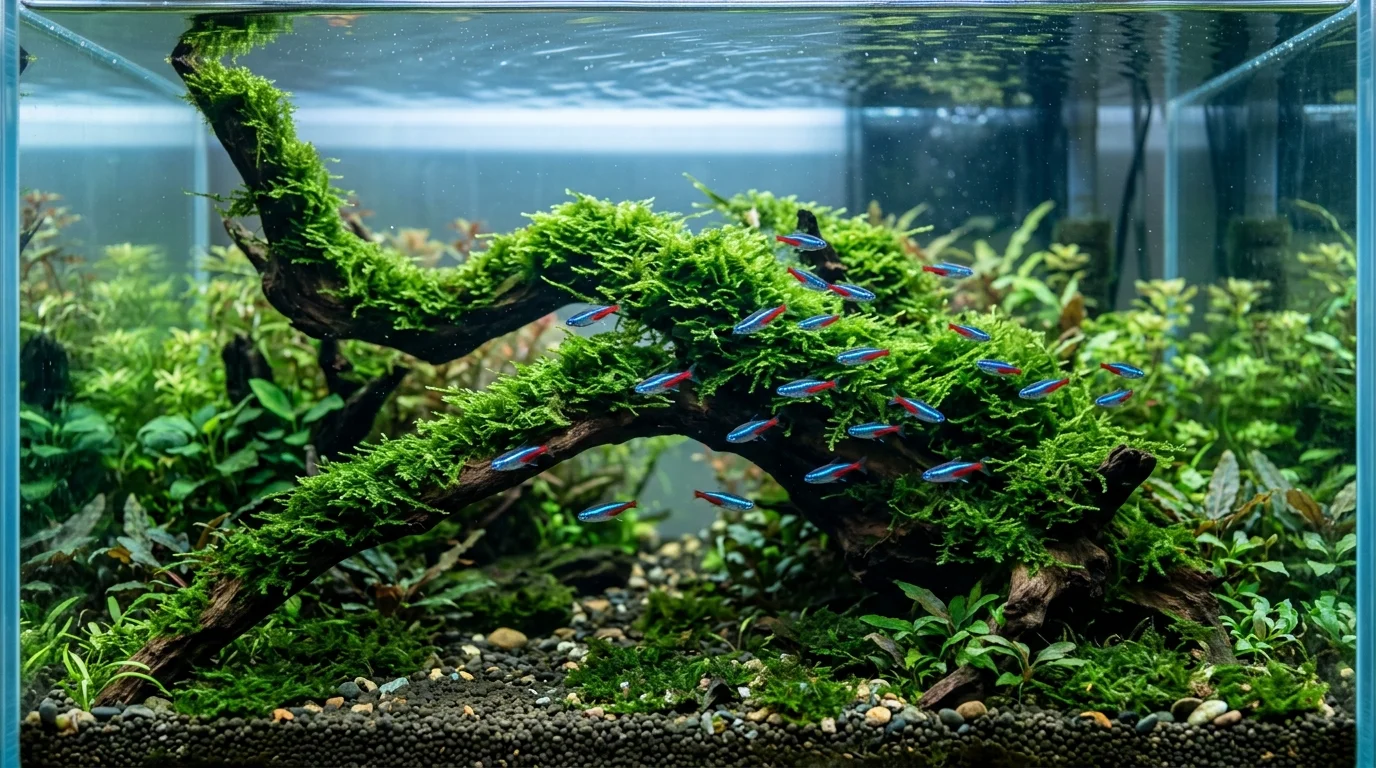
Marimo moss balls, despite their name and widespread use in aquariums, are not moss. They are a spherical form of filamentous green algae called Aegagropila linnaei, which forms into balls through the rolling action of lake currents in their native habitat in Japan, Iceland, and parts of Europe. They behave very differently from true mosses, grow far more slowly, and require different care. Understanding this distinction matters practically because advice that works for java moss will not work for a marimo ball and vice versa.
Aquatic mosses are also different from terrestrial garden mosses that grow on rocks and soil outdoors. Land mosses can survive submerged for short periods and some hobbyists experiment with adding them to tanks, but most terrestrial moss species gradually deteriorate underwater as they cannot photosynthesise efficiently when fully submerged. True aquatic moss species have evolved specifically for underwater growth and perform reliably in a properly maintained tank over years rather than weeks.
The Best Moss Types for a Fish Tank
Java moss is the most widely available and hardiest aquarium moss species. Its scientific name is Taxiphyllum barbieri, and it tolerates a wider range of conditions than any other commonly kept aquatic moss. Water temperature between 15 and 30 degrees Celsius, pH from 5.0 to 8.0, and a wide range of water hardness all fall within its acceptable range. This tolerance makes java moss the right starting point for anyone new to growing moss in a fish tank. It grows with a loose, slightly tangled habit that some aquascapers find less refined than other species, but this same quality makes it ideal for breeding tanks and shrimp tanks where dense, irregular coverage provides hiding spots and grazing surfaces.
Christmas moss takes its name from the distinctive layered growth pattern of its fronds, which overlap like the branches of a conifer tree. Its scientific name is Vesicularia montagnei. Christmas moss produces a more elegant, structured appearance than java moss and is commonly used in aquascaping for this reason. It prefers slightly cooler water than java moss, performing best between 18 and 24 degrees Celsius. At temperatures above 26 degrees Celsius, its growth slows and the characteristic layered form becomes less defined. Christmas moss grows more slowly than java moss but produces a cleaner, more compact result that suits display tanks.
Flame moss grows vertically in tightly spiralling strands that give it a distinctive upright flame-like appearance. Scientifically classified as Taxiphyllum sp. “flame,” it remains compact and does not spread across surfaces as aggressively as java or christmas moss. This makes it particularly useful as a midground accent plant in aquascapes rather than as a background or carpet plant. Flame moss prefers temperatures between 18 and 26 degrees Celsius and benefits from moderate water flow to keep its strands open and uncompacted.
Weeping moss, Vesicularia ferriei, produces fronds that hang downward rather than growing outward or upward. When attached to a piece of elevated driftwood, the downward-growing fronds create a waterfall effect that is highly valued in aquascaping. Weeping moss grows slowly and performs best in cooler water between 18 and 24 degrees Celsius. It is less tolerant of poor water quality than java moss and requires more consistent maintenance to stay healthy.
Taiwan moss and peacock moss are two additional species that produce refined, detailed structures appealing to experienced aquascapers. Both grow slowly, prefer cooler temperatures, and require better water quality and more consistent CO2 and nutrient levels than java or christmas moss. They are better choices for a second or third moss species after you have successfully established a hardier variety in the same tank.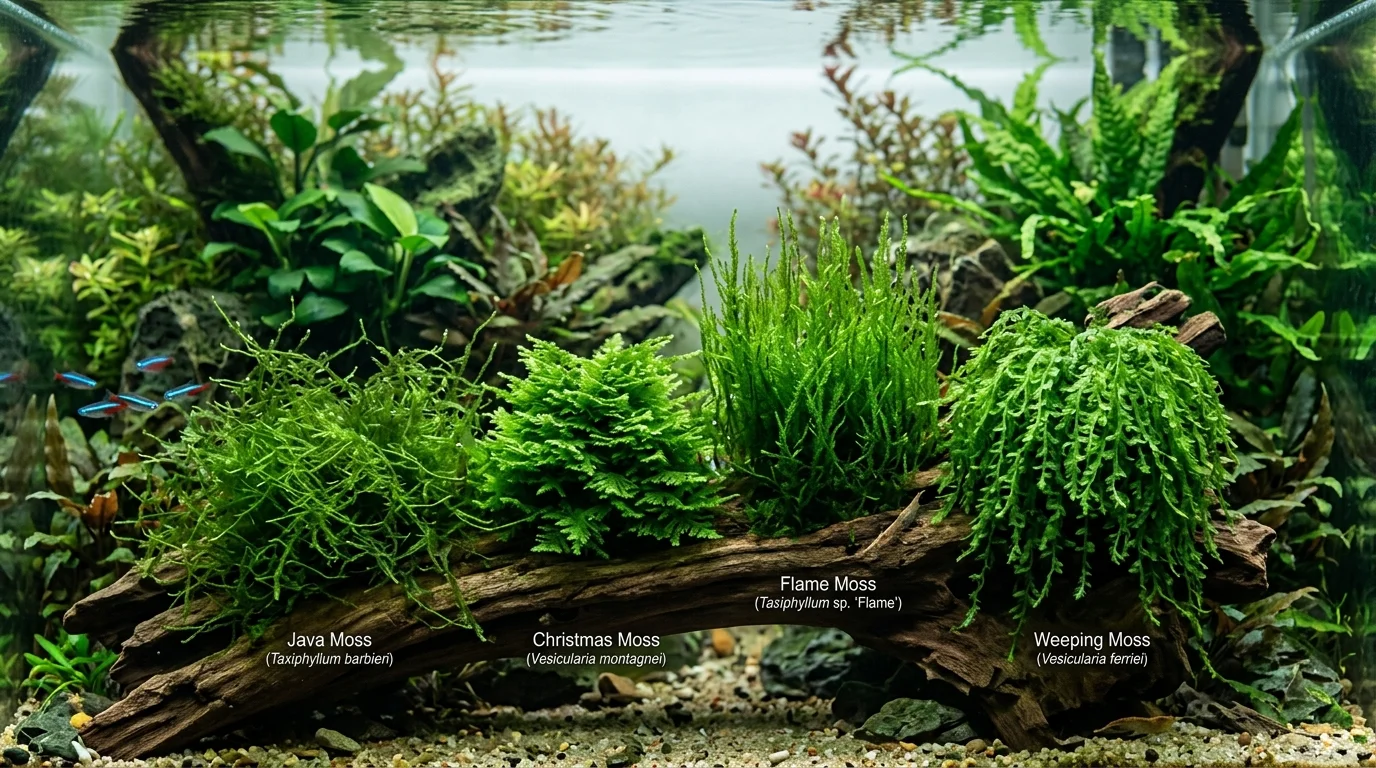
How to Attach Moss to Driftwood and Rocks
Aquatic mosses do not attach themselves to surfaces immediately. Given time, the rhizoids will grow into any rough surface they are pressed against and form a permanent bond, but this process takes several weeks to months depending on the species and conditions. During this establishment period, the moss needs to be held in contact with the surface it is meant to colonise. Three methods work reliably, each with practical trade-offs.
Fishing line is the most durable attachment method and the easiest to apply neatly. Use thin monofilament at 0.1 to 0.2mm diameter, which is almost invisible in a planted tank. Cut a piece of moss to a manageable size, roughly two to three centimetres across, and press it flat against the driftwood or rock surface. Wind fishing line around the piece repeatedly in different directions until the moss is held firmly without being crushed. The line stays in place indefinitely, which means you never need to worry about it dissolving before the moss attaches. The only downside is that fishing line remains visible until the moss grows over it, and in some tanks fish or invertebrates occasionally snag on loose ends if the line is not trimmed close to the surface.
Cotton thread is an alternative to fishing line that dissolves naturally over eight to twelve weeks as the cotton fibres break down. By the time the thread disappears, the moss should have developed enough rhizoid attachment to hold itself in place. The practical risk is that in tanks with faster-flowing water or active fish, the dissolution process can leave trailing fibres before the moss has properly anchored. If the moss detaches when the thread dissolves, the whole process needs to start again. Cotton thread works best in calm tanks with gentle water movement.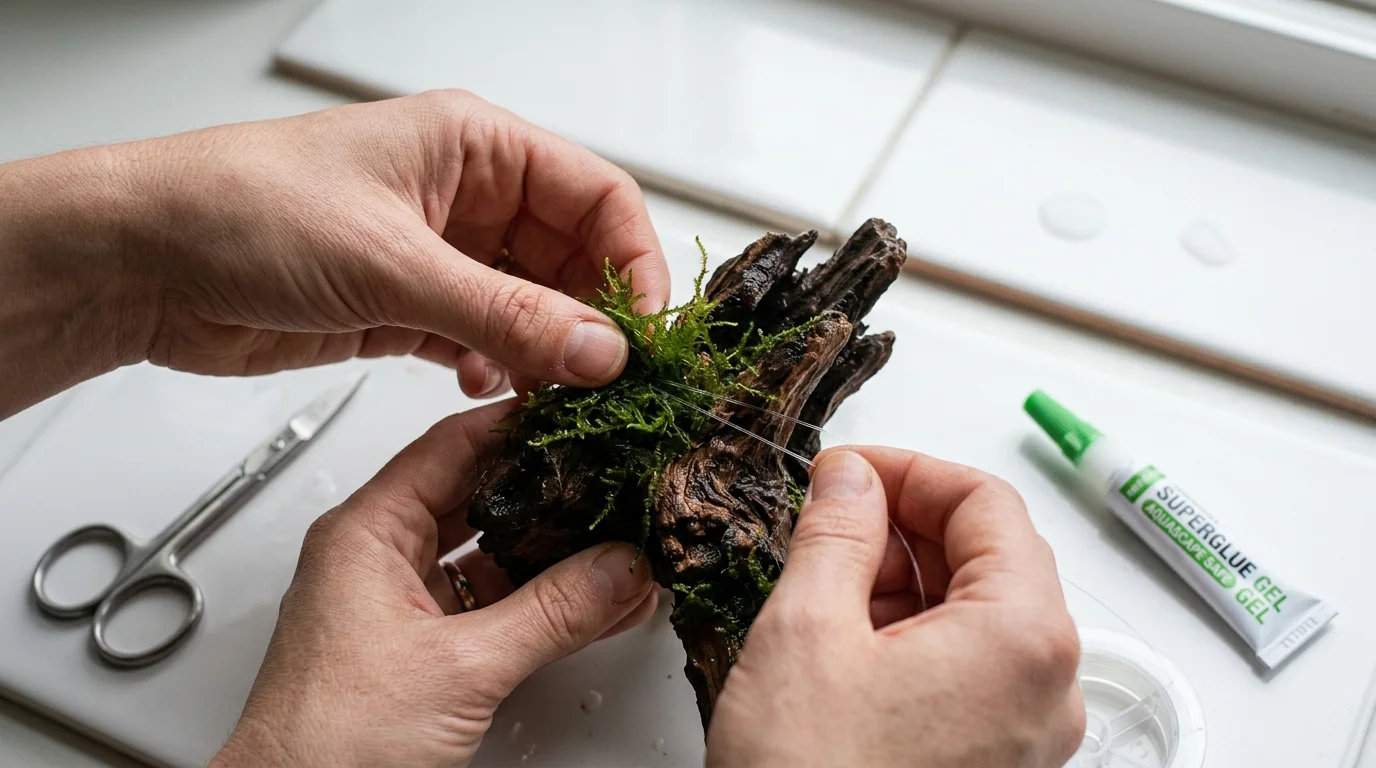
Aquarium-safe superglue, specifically gel-type cyanoacrylate, allows precise placement of small moss pieces with no thread required. Apply a small drop of gel to the surface you want to colonise, press a fingertip-sized piece of moss against it, and hold for fifteen to twenty seconds. The bond forms quickly and holds even in flowing water. Superglue leaves a white residue initially, but moss growth covers this within a few weeks. This method is particularly useful for attaching small moss pieces to detailed hardscape where threading is impractical. Cyanoacrylate is safe for fish, shrimp, and other tank inhabitants once fully cured, which happens within seconds of contact with water.
One of the most consistent mistakes when attaching moss to hardscape is applying it in a thick layer under the assumption that more moss means faster coverage. Thick layers trap debris and block light from reaching the inner fronds, which die back and create a brown, decomposing core beneath the visible green surface. The outer layer looks healthy for several weeks while the moss underneath is rotting, and when the dead inner layer eventually releases, sections of apparently healthy moss detach from the surface in patches. The correct technique is to attach moss in a thin single layer, roughly three to five millimetres deep, and allow it to grow outward from that base over time. A thin layer that stays green all the way through performs consistently better than a thick clump that looks impressive for the first month and then deteriorates.
Water Conditions and Light Requirements for Healthy Moss Growth
Temperature is the most important water parameter for aquarium moss and the one most commonly overlooked. All true aquatic mosses prefer cooler water than typical tropical fish, and most species begin to show reduced growth, colour changes, and deteriorating form when temperatures consistently exceed 26 degrees Celsius. Java moss is the most temperature-tolerant species, maintaining acceptable growth up to 30 degrees Celsius, but even java moss produces its best, most compact growth in water between 20 and 24 degrees Celsius.
This temperature preference creates a genuine conflict in tropical fish tanks where heaters maintain temperatures of 25 to 28 degrees Celsius for the fish. The practical solution is to choose java moss specifically for warm tanks and accept that it will grow with a slightly looser, less structured form than it would in cooler water. For tanks kept below 25 degrees Celsius for cool-water species like goldfish or certain barbs, christmas moss, weeping moss, and flame moss all perform excellently and produce their characteristic structured growth forms.
Light requirements for aquatic moss are lower than for most other aquarium plants. All common moss species survive in low light conditions and are among the few aquarium plants that remain green and grow without dedicated plant lighting. A basic LED aquarium light running eight hours per day provides enough light for java moss and christmas moss to grow at a reasonable pace. Higher light levels accelerate growth but also increase the risk of algae colonising the moss surface, which is one of the main long-term challenges in moss maintenance.
Water flow benefits moss growth by delivering CO2 and dissolved nutrients directly to the leaf surfaces where absorption occurs. Position your filter outlet so that gentle current passes across moss-covered surfaces without blasting them with direct turbulent flow. Strong direct current can prevent rhizoids from establishing contact with the attachment surface and keep free-floating moss from settling. According to the Food and Agriculture Organization of the United Nations, aquatic plants including mosses play an important role in maintaining water quality in closed aquatic systems by absorbing dissolved nitrogen compounds. In a fish tank this means your moss is actively processing the nitrates produced by fish waste, which is a genuine water quality benefit beyond the visual contribution.
Moss for Shrimp Tanks and Breeding Setups
Aquarium moss is particularly valuable in shrimp tanks and fish breeding setups for reasons that go beyond appearance. Dense moss provides physical shelter for juvenile shrimp and fish fry that would otherwise be predated by adult tank inhabitants. The irregular, tangled structure of java moss in particular creates thousands of small hiding spaces that small invertebrates and newborn fish navigate easily while larger fish cannot enter.
Moss also provides a grazing surface for shrimp. Biofilm, the thin layer of microorganisms that colonises any surface in an established aquarium, grows prolifically on moss fronds because the irregular surface area is much larger than smooth rock or glass. Shrimp graze this biofilm continuously and actively. A tank with established moss coverage supports a noticeably larger shrimp population at healthy weights than the same tank without moss, assuming other parameters are equal.
For egg-scattering fish species, floating or loosely anchored moss provides a spawning site and protects deposited eggs from being eaten by the parents. Many killifish, tetras, and danio species deposit eggs among floating vegetation naturally, and java moss floating at the water surface mimics this environment accurately enough that breeding success rates improve in tanks with moss compared to bare tanks.
Growers managing other aquatic biology, including those working on beneficial bacteria in pond systems, will recognise the parallel principle at work here. Moss increases the available surface area in the tank, which supports larger populations of beneficial nitrifying bacteria as well as the biofilm that shrimp depend on. The ecological relationships in a moss-covered tank are more complex and self-sustaining than in a bare tank, which generally translates to more stable water chemistry and healthier inhabitants.
Why Aquarium Moss Turns Brown and How to Fix It
Brown moss in a fish tank is one of the most common problems aquarists encounter and it has several distinct causes that require different responses. Identifying the correct cause before making changes is important because the wrong intervention can make the problem worse rather than better.
Algae colonisation is the most frequent cause of brown or reddish-brown discolouration in aquarium moss. When algae grows on moss fronds faster than the moss can grow through it, the algae shades the moss leaves and the moss tissue beneath begins to die. The brown colour comes from this dying moss tissue rather than the algae itself. Reducing light duration or intensity, increasing water changes to lower nitrate levels, and trimming affected sections of moss all help address algae pressure. Adding algae-eating invertebrates such as amano shrimp or nerite snails provides ongoing biological algae management that reduces the frequency of manual intervention.
Temperature stress produces a different type of browning. When water temperature rises above the comfortable range for a given moss species, the outer fronds begin to yellow and then brown while the inner growth may remain green. If the browning follows a period of warmer weather or a heater malfunction, temperature is likely the cause. Lowering temperature gradually to the appropriate range for your moss species usually produces visible improvement within two to three weeks as new growth replaces the damaged fronds.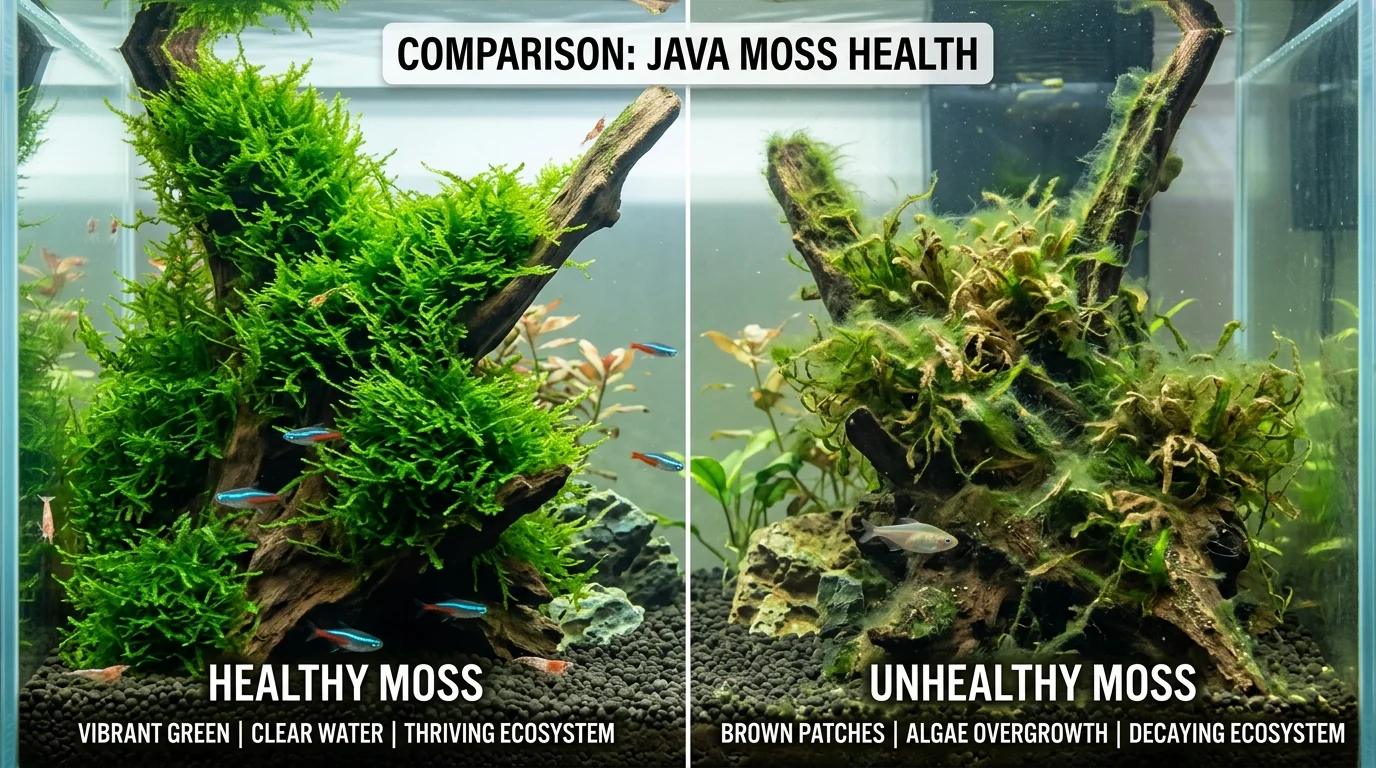
Poor water flow causes browning in specific patches where circulation is inadequate. Sections of moss that receive no water movement trap debris, develop pockets of low oxygen concentration, and develop brown patches while better-circulated sections remain green. Adjusting filter outlet direction or adding a small circulation pump usually resolves flow-related browning within a few weeks. Regular pruning of moss also improves internal airflow and light penetration, which prevents the compacted interior browning that affects thick, untrimmed clumps.
Trimming and Long-Term Maintenance
Aquarium moss grows continuously and requires regular trimming to maintain its form and prevent it from overtaking other plants and hardscape features. Java moss in particular can spread aggressively under good conditions, with fragments detaching and colonising other parts of the tank if not managed. A regular trimming routine every two to four weeks keeps moss compact, encourages fresh new growth from the trimmed tips, and prevents the interior die-back that affects untrimmed clumps.
Use sharp aquascaping scissors rather than standard scissors for trimming. Blunt cuts tear moss fronds rather than cutting them cleanly, which leaves ragged edges that are more susceptible to algae colonisation at the cut surface. After trimming, remove all clippings from the tank with a fine net before they settle and begin growing in unwanted locations. Moss fragments as small as a few millimetres can establish new growth if they land on a suitable surface and are left undisturbed.
The removed moss clippings have value. Healthy trimmed fragments can be replanted in new locations, given to other hobbyists, or used to establish moss in a second tank. Unlike most aquarium plants, moss does not require special propagation. Any healthy fragment with intact fronds will continue growing when placed against a surface in suitable conditions. This makes aquarium moss one of the most economical long-term plant investments for an aquarist, since the original purchase effectively multiplies itself over time through regular maintenance trimming. The same principle applies across many slow-growing but self-perpetuating plant systems, including slow-growing plants raised from seed where patience in the establishment phase produces a plant that continues growing and propagating for years with minimal input.