
Healthy agricultural pond water does not maintain itself. Whether you are managing a fish farming operation, an irrigation reservoir, a livestock watering pond, or a rice paddy system, the invisible biological workforce beneath the surface determines whether your water works for your farm or against it. Billions of beneficial bacteria continuously break down fish waste, animal runoff, decaying organic matter, and excess agricultural nutrients that would otherwise accumulate into toxic sludge, algae blooms, and diseased water. These microorganisms are the foundation of every productive aquatic farming system, and understanding how to grow them naturally is one of the most cost-effective decisions any agricultural producer can make.
The global pond management industry generates over $1.2 billion annually in bottled bacterial products and chemical treatments. Most address symptoms rather than root causes. Building a self-sustaining bacterial colony within your own agricultural pond ecosystem delivers long-term water quality results that no purchased product can replicate season after season, and the biology behind it is straightforward enough for any farmer to apply.
Why Local Bacteria Outperform Commercial Products in Agricultural Ponds
Every agricultural water body, from a tilapia grow-out pond in the American Southeast to a catfish farm in the Mississippi Delta, already contains the biological raw material needed for effective natural water treatment. Naturally occurring bacteria from the genera Nitrosomonas, Nitrobacter, Bacillus, and Pseudomonas are present in virtually every outdoor pond environment. The real question is never whether these organisms exist. The question is whether your pond conditions allow them to reproduce and function at concentrations high enough to keep pace with the organic load your farming operation generates.
Nitrosomonas bacteria perform the most critical chemical reaction in any stocked agricultural pond. They convert ammonia, produced by fish respiration, livestock waste, fertilizer runoff, and decomposing organic matter, into nitrite through nitrification. Ammonia above 0.5 milligrams per liter is acutely toxic to fish and begins suppressing the very bacterial activity that would clear it. Nitrobacter then converts nitrite into nitrate, a far less toxic compound that aquatic plants and algae absorb as a nutrient. This two-step biological chain, running continuously through a healthy bacterial population, is what prevents ammonia from reaching lethal levels in any stocked or working pond.
Research published through the USDA Natural Resources Conservation Service confirms that locally adapted bacterial communities consistently outperform introduced commercial strains in long-term water quality management. Bacteria that have already established themselves in your specific pond have adapted to your water temperature range, pH, dissolved minerals, and organic chemistry. Commercial strains grown under laboratory conditions rarely survive competitive pressure from resident microbial populations once the bottle runs out.
Just as farmers who grow alfalfa rely on naturally occurring soil bacteria to fix atmospheric nitrogen rather than purchasing nitrogen inputs every season, pond managers who build conditions for their existing microbial community get more consistent and lower-cost results than those chasing short-term fixes from a product label.
What Beneficial Bacteria Need and How to Provide It Naturally
The single most important fact about beneficial bacteria in agricultural ponds is that they do not float freely through the water column. The vast majority of nitrifying and decomposing bacteria live attached to surfaces in dense colonies called biofilms. These are structured microbial communities anchored in a self-produced matrix of proteins and polysaccharides that glues them to gravel, rocks, root systems, pond liners, inlet structures, and filter media.
Surface area drives bacterial carrying capacity more than any other single factor. A clay-lined farm pond with bare walls, minimal bottom substrate, and no aquatic vegetation has almost no biofilm habitat. The same volume of water in a pond with a gravel bottom layer, submerged rock structures near inlets, productive plant margins, and a simple biological filter can support bacterial populations many orders of magnitude larger. Studies of biofilm density across substrate materials consistently show that rough-textured materials including lava rock, ceramic bio-media, natural river gravel, and broken brick support bacterial counts three to five times higher than smooth surfaces.
Practical steps agricultural pond managers across the United States can take to increase bacterial habitat include adding clean river gravel or broken brick to shallow inlet zones where nutrient-rich water enters the pond, installing simple PVC bio-filter frames filled with coarse aggregate near pond inlets, establishing productive plant margins using locally available emergent plants such as reeds, bulrushes, or cattails in controlled zones, and placing loose rock piles in shallow areas of fish ponds to create protected biofilm surface area.
Aquatic margin plants deserve special attention in agricultural systems. Their root systems are among the most productive biofilm habitats in any pond. The same mechanism by which field crops support soil microbial diversity through root exudates operates below the waterline with emergent pond plants, driving bacterial colonization and nutrient cycling continuously through the growing season.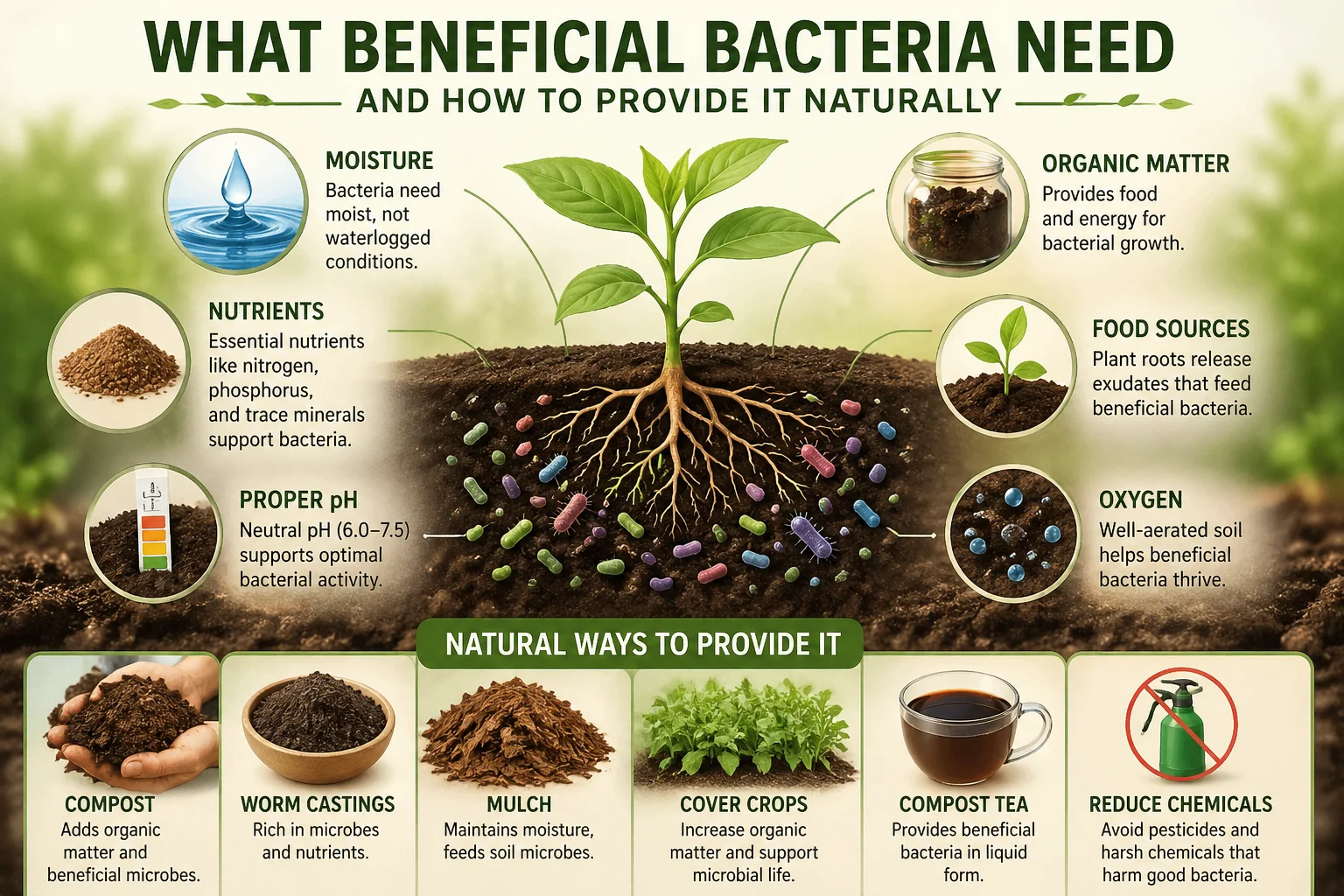
Getting the Carbon and Nitrogen Balance Right for Agricultural Systems
Agricultural ponds typically carry heavier nitrogen loads than ornamental ponds. Fish feed, animal waste, and fertilizer runoff all introduce nitrogen at rates that can overwhelm natural bacterial processing if not managed deliberately. The ratio of available carbon to available nitrogen, commonly called the C:N ratio, determines which biological process dominates in your pond at any given time.
At C:N ratios above 25:1, heterotrophic bacteria that consume carbon-rich organic matter dominate decomposition, breaking down feed residue, dead plant material, and organic sediment. At C:N ratios below 10:1, nitrifying bacteria responsible for ammonia conversion take precedence. Most productive agricultural ponds naturally shift between these zones depending on seasonal inputs and management decisions.
Farmers can influence this balance directly. Adding barley straw in mesh bags near pond inlets, or incorporating small quantities of agricultural molasses at rates below 5 ppm during low-carbon periods, stimulates heterotrophic bacterial activity and shifts biological chemistry away from algae-dominated conditions. Research from the Centre for Aquatic Plant Management in the United Kingdom found that aerobic decomposition of barley straw produces compounds at concentrations sufficient to suppress algal cell division without harming fish, invertebrates, or the bacterial communities driving filtration.
Oxygen Management in Working Farm Ponds
Nitrifying bacteria are obligate aerobes, meaning they require dissolved oxygen to survive and function. Nitrosomonas and Nitrobacter are particularly sensitive to oxygen depletion because their metabolic rate is already lower than most other bacterial groups, making them the first community to collapse when oxygen levels drop. Dissolved oxygen below 2 mg/L causes nitrification rates to fall by more than 50 percent. Below 1 mg/L, the process stops almost entirely and ammonia accumulates rapidly, a scenario that can produce mass fish kills in high-density aquaculture systems within hours.
Productive agricultural ponds should maintain dissolved oxygen between 6 and 10 mg/L throughout the full water column, not just at the surface. Summer thermal stratification, where warm low-oxygen water forms a stable layer above cooler oxygenated bottom water, is one of the primary drivers of bacterial community collapse in stagnant farm ponds across the American South and Midwest. Bottom water in stratified ponds frequently drops below 1 mg/L, creating anaerobic zones that produce toxic hydrogen sulfide rather than the clean nitrogen cycling that beneficial bacteria maintain.
Aeration is not optional in any agricultural pond carrying a meaningful fish or nutrient load. Practical aeration options for U.S. farm ponds include paddle wheel aerators, which are widely used in commercial catfish and tilapia operations throughout the Southeast and are highly effective at surface oxygenation and destratification. Subsurface diffuser systems deliver compressed air through perforated tubing along the pond bottom and work best for breaking up stratification in deeper ponds.
Expert Insight Note
UV sterilization systems, commonly installed in recirculating aquaculture systems and intensive pond operations for pathogen control, directly antagonize biological filtration when run continuously on the main flow path. UV irradiation kills not only pathogens but also the free-floating nitrifying bacteria that have detached from biofilm surfaces to recolonize new substrate areas. In systems where UV sterilizers run 24 hours across the main filtration flow, beneficial bacterial populations become trapped on existing biofilm surfaces with no capacity to expand or recover after cleaning, pond disturbance, or seasonal die-off. The recommended approach is to position UV units on a bypass loop operating for no more than 8 to 12 hours per day during disease pressure periods rather than continuously year-round.
What the Bottled Bacteria Industry Gets Wrong for Farmers
Commercial beneficial bacteria products are marketed aggressively to agricultural pond operators across the United States, and the promise is compelling. Add a measured dose of concentrated bacterial solution and see water quality improve within days. The marketing draws on real science about bacterial function, but the practical results in field conditions consistently fall short of what labels suggest.
The core problem is survival rate. A 2019 review in the journal Aquaculture examining commercial probiotic bacterial products in pond systems found that introduced strains typically declined to undetectable levels within 7 to 21 days in field conditions, displaced by resident microbial communities already adapted to each site’s specific environmental chemistry.
Many products rely on spore-forming Bacillus strains because spores survive storage and shipping far better than vegetative bacterial cells. Bacillus organisms do contribute to decomposition of organic sludge and can show measurable short-term improvement in bottom sediment accumulation rates, which is useful for some applications. However, Bacillus organisms do not perform nitrification. They do not convert ammonia or nitrite. Farmers purchasing these products expecting ammonia control and water clarity often see partial sediment improvement while their nitrogen cycle remains completely unchanged and their fish losses continue.
The Long-Term Damage Chemical Treatments Leave in Agricultural Water Bodies
Chemical treatments including copper sulfate algaecides, diquat and fluridone herbicides, and chlorine bactericides achieve their immediate objectives through mechanisms fundamentally incompatible with the biological communities that make those treatments unnecessary over time. Copper sulfate suppresses algal blooms effectively at 0.1 to 0.5 mg/L. At those same concentrations, copper is acutely toxic to the invertebrate communities, including aquatic insects, crustaceans, and mollusks, that form the base of the aquatic food web and provide natural grazing pressure on algae.
The impact on beneficial bacterial communities is equally severe. A single copper sulfate application can reduce nitrifying bacterial populations in pond sediment by 70 to 90 percent, as documented across multiple university extension programs in the American Southeast. Recovery of the nitrification function typically requires four to eight weeks under ideal conditions. During this period ammonia accumulates, fish stress increases, and producers frequently apply additional chemical treatments that extend the recovery timeline further.
Herbicide applications targeting emergent shoreline vegetation cause agricultural pond damage that operates on a longer timeline and is rarely connected to its cause by pond managers who apply it. Cattails, bulrushes, and shoreline sedges are removed because they reduce open water area or interfere with equipment access. However, their root systems provide the primary biofilm substrate for the bacterial communities processing the nutrient inputs that enter the pond from surrounding agricultural land.