
Lithops are among the most unusual plants a grower can raise from seed. These small succulents from southern Africa have spent millions of years evolving to look exactly like the pebbles and stones around them. Grazing animals walk right past them without realising they are plants at all. That same evolutionary toughness makes them fascinating to grow, but it also means they follow rules that are completely different from almost every other plant you have ever grown.
Growing lithops from seed is not a fast project. From germination to a flowering adult plant takes three to four years. What it is, however, is genuinely rewarding. A healthy collection of lithops in different species produces an astonishing range of colours, patterns, and textures that no other plant group can match. Getting there starts with understanding what these plants actually need, which is almost the opposite of what most people assume.
What Lithops Are and Where They Come From
Lithops are succulent plants native to the desert and semi-desert regions of South Africa and Namibia. They grow in rocky, mineral-poor soil with annual rainfall of just 50 to 200 millimetres, which is less than most cacti receive in cultivation. Each plant consists of a single pair of fleshy leaves fused together into a shape that resembles a small stone. A narrow fissure runs across the top of the plant, and it is from this groove that new leaves and flowers emerge each year.
The name lithops comes from the ancient Greek words lithos, meaning stone, and ops, meaning face. The common name “living stones” describes them accurately. Each species has evolved to match the exact colour and texture of the rock substrate in its specific native habitat. Lithops olivacea grows among quartz outcrops and has developed a matching olive-green colouring. Lithops ruschiorum mimics the buff and pink tones of feldspar rock in Namibia. This level of camouflage is not decorative. It is the plant’s primary survival strategy against animals that would otherwise eat it for its water content.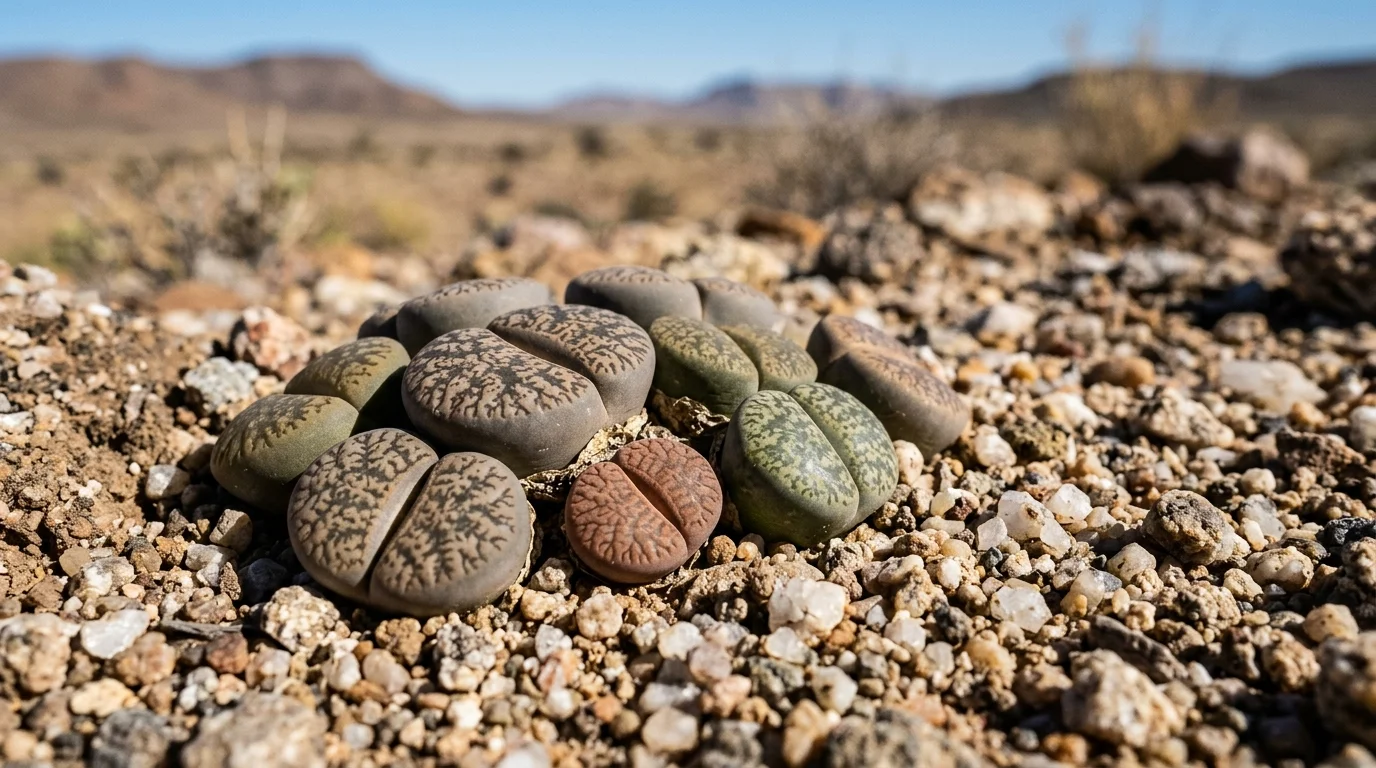
Understanding the native environment of lithops is not background information. It is essential practical knowledge. Every growing decision you make, from soil composition to watering timing to light levels, should reference what conditions these plants evolved in. Growers who treat lithops like general houseplants almost always lose them within the first two years.
Choosing and Sourcing Lithops Seeds
Lithops seeds are extremely small, roughly the size of fine dust particles, and quality varies significantly between suppliers. Buying from a specialist succulent seed supplier rather than a general garden retailer is worth the extra effort. Reputable suppliers who specialise in mesembryanthemums, the plant family that includes lithops, offer better viability rates and accurate species labelling. Poorly sourced seeds often have low germination rates or are mislabelled species that disappoint growers expecting specific colours or patterns.
Seeds can be stored for several years before sowing without significant loss of viability, provided storage conditions are correct. Keep them in a sealed airtight container in a dark, dry, cool location. A sealed paper envelope inside a zip-lock bag placed in a cool cupboard works well. Exposure to humidity is the main enemy of stored lithops seeds. A seed that feels normal to the touch can have lost all viability from a single period of moisture exposure if storage was poor.
Different species within lithops vary in difficulty. Beginners consistently have better results starting with species from the higher-rainfall regions of South Africa’s Eastern Cape. Lithops aucampiae and Lithops fulviceps are particularly recommended because they tolerate slightly more variable watering than desert-extreme species and give growers more margin for error during the learning phase. More demanding species like Lithops julii or Lithops optica are better tackled once you have successfully raised at least one generation of easier species.
The Right Soil Mix for Germinating Lithops Seeds
Soil preparation is where most first-time lithops growers go wrong, and the consequences show up months later when seedlings suddenly collapse for no apparent reason. Standard potting compost holds far too much moisture for lithops at any stage of growth, but it is especially harmful at the seedling stage when roots are shallow and the risk of rot is highest.
The correct germination mix consists of roughly 50 percent coarse inorganic material and 50 percent cactus compost or a very low organic potting mix. Suitable inorganic materials include pumice, fine grit at one to three millimetres grain size, perlite, or coarse sand. Pumice is the preferred choice among experienced growers because it retains just enough moisture to support germination while draining freely enough to prevent waterlogging. Pure vermiculite can also work for germination but requires supplemental nutrients since it has no natural mineral content.
Sterilising the germination mix before sowing significantly improves success rates by eliminating fungal spores and competing microorganisms that would otherwise attack the fragile seedlings. Spread the moistened mix in a heat-proof tray and bake at 120 degrees Celsius for 30 minutes. Allow it to cool completely before sowing. This step is not strictly necessary but experienced growers consistently report better germination rates and lower seedling losses when they sterilise.
Fill your sowing containers to within one centimetre of the top. Shallow trays do not provide enough depth for the taproot that lithops develops early in its life. Use containers at least six to seven centimetres deep. Terracotta pots dry faster than plastic and are generally preferred for mature plants, but for germination, plastic containers or seedling trays with drainage holes work well because they hold humidity more consistently during the critical germination window.
How to Sow Lithops Seeds Correctly
Because lithops seeds are so small, even distribution across the soil surface requires more care than sowing larger seeds. Pouring directly from the packet almost always creates dense clumps in some areas and bare patches in others. Clumped seedlings compete with each other, grow more slowly, and are much harder to separate without damage when the time comes to transplant them.
A practical technique is to mix the seeds with a small amount of fine dry sand or salt before sowing. This dilutes the seed concentration and makes even distribution across the soil surface much easier. Another approach used by experienced collectors is to fold a piece of paper, pour the seeds into the fold, and gently tap the paper to release seeds one at a time in a controlled pattern across the soil.
Press seeds lightly onto the soil surface using a flat tool or the tip of a finger. Do not bury them. Lithops seeds need light to germinate and should remain at or just below the soil surface. After pressing seeds in, add a very thin layer of fine grit at one to two millimetres grain size over the entire surface. This thin top layer serves two functions. It holds the seeds in contact with the moist soil below while also protecting them from direct sun exposure that would otherwise dry them out before germination can begin.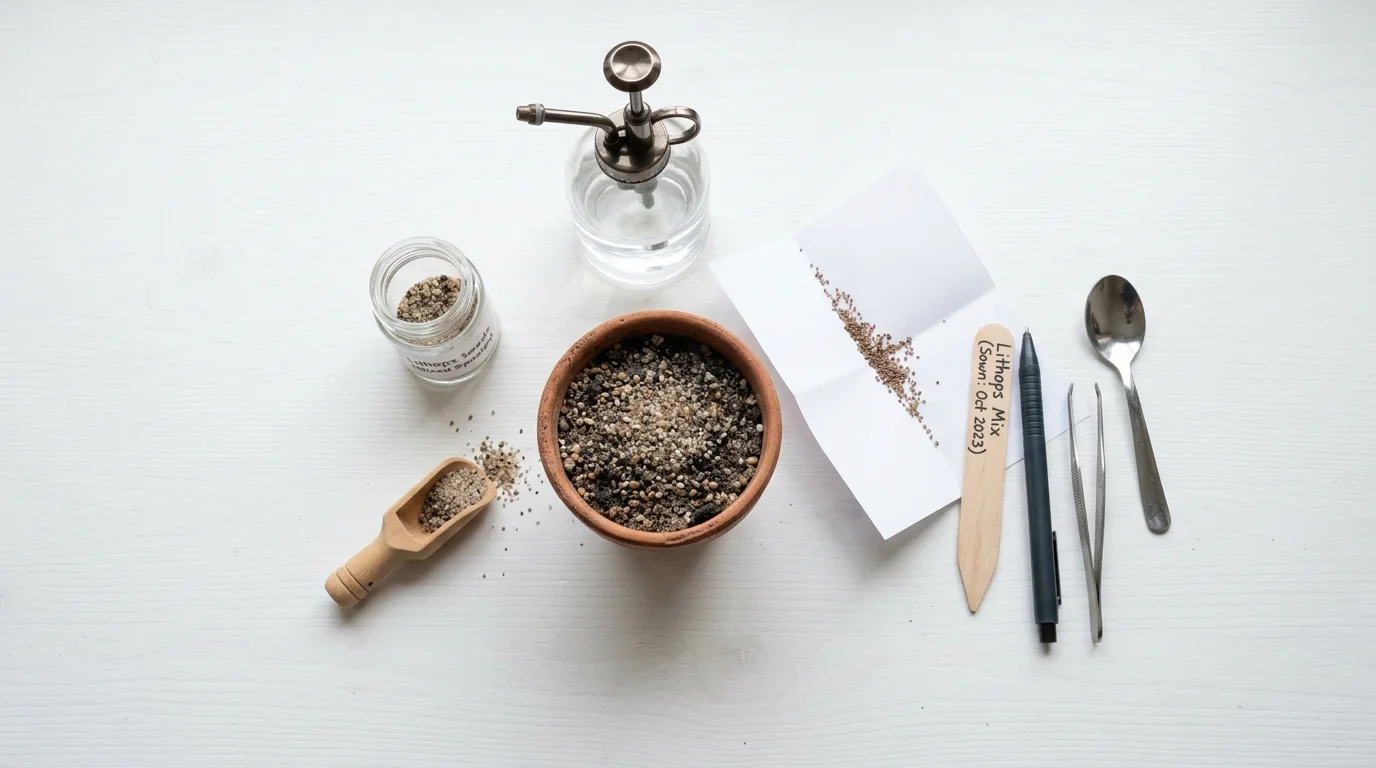
Water from below rather than above at this stage. Place the sowing container in a tray of water and allow the soil to draw moisture upward through capillary action until the surface shows signs of dampness. Remove the container from the water tray before the surface becomes saturated. Top watering with a watering can disturbs the seeds and the thin grit layer, which disrupts the micro-environment the seeds need for germination.
Expert Insight Note
One of the most damaging mistakes in lithops seed growing is removing the humidity cover too quickly after germination. Many growers see the first seedlings emerge and immediately expose the entire tray to open air, which causes a rapid drying effect that kills newly germinated seedlings before their roots have grown deep enough to access moisture from the lower soil layers. The correct approach is to begin opening the cover for just two hours per day once most seeds have germinated, then gradually increase the open period over seven to ten days. This slow hardening process allows the seedlings to adjust to lower humidity without the shock of sudden exposure. Lithops that die in the first two weeks after germination almost always die from this transition being handled too fast, not from disease or poor soil.
Temperature and Light During Germination
Temperature control during the germination period is more precise for lithops than for most other plants. The ideal daytime temperature range is 20 to 25 degrees Celsius, with night temperatures dropping to 10 to 15 degrees Celsius. This temperature differential between day and night mirrors the conditions in the natural habitat of lithops during the seasons when seeds germinate in the wild. Germination outside this range is possible but produces uneven and slow results.
Autumn and spring are the recommended sowing seasons for this reason. Outside temperatures naturally fall within the correct range without artificial heating or cooling. Summer sowing fails most often because daytime heat exceeds 28 degrees Celsius, which dramatically slows germination and increases the risk of fungal rot in the moist germination environment. Winter sowing is possible with a heated propagator that maintains the base temperature, but it requires more active management.
Light requirements during germination are significant but indirect. Place the covered germination tray in a bright location that receives no direct sun during the hottest part of the day. Direct sun through glass or clear plastic raises the temperature inside the cover to levels that can kill seeds before they germinate. A bright north-facing windowsill in the northern hemisphere, or a location with morning sun and afternoon shade, provides the right balance. If using artificial grow lights, position them at least 30 centimetres above the germination tray and run them for 12 to 14 hours per day.
Germination typically begins within 10 to 15 days under good conditions. Some seeds in the same batch may take up to three months or longer. This is normal lithops behaviour and not a sign of failure. According to the Royal Botanic Gardens Kew’s Plants of the World Online, lithops seeds have evolved to germinate across extended periods rather than all at once, which in their natural habitat spreads the risk of seedling mortality from a single drought event. Keep the germination environment consistent and do not give up on a tray that appears slow to respond.
Caring for Lithops Seedlings in the First Year
Newly germinated lithops seedlings are tiny. In the first weeks after emergence, each seedling is no bigger than two to three millimetres across. They are vulnerable at this stage to fungal attack, physical disturbance, and sudden changes in humidity or temperature. The most important management task in the first three months is maintaining consistent conditions rather than doing anything active to the plants.
Water seedlings from below every three to four days during the first three months. The soil should remain evenly moist but never saturated. A seedling that sits in waterlogged soil for even a few days at this stage will rot from the base upward and cannot be saved once the process begins. After three months, begin extending the dry period between waterings gradually. By six months after germination, seedlings should be experiencing short dry periods of four to seven days between waterings.
Keep seedlings in their communal germination tray for 12 to 18 months before attempting to separate them into individual pots. Transplanting too early damages the developing taproot and sets seedlings back significantly. When the plants are large enough to handle without damaging them and have clearly developed their characteristic paired leaf structure, they are ready for individual containers. Use a deeper pot than seems necessary because lithops develop a surprisingly long taproot relative to their visible above-ground size.
Growers who manage other slow-developing seed-grown plants understand this same requirement for patience. Just as growing a cactus from seed demands months of careful management before the plant reaches a size where it can tolerate less attentive care, lithops seedlings reward growers who resist the urge to intervene unnecessarily and instead focus on maintaining stable conditions.
What Most People Get Wrong When Growing Lithops
Overwatering is the most common reason lithops die in cultivation, and it kills plants at every stage from seedling to mature adult. The watering instinct that works for most houseplants is actively harmful to lithops. These plants experience a genuine dormancy period in summer, during which they should receive no water at all. They also go through a leaf replacement cycle each year during which watering must stop completely to allow the old leaves to shrivel and transfer their moisture to the new pair emerging from the central fissure.
Watering during the wrong phase of this annual cycle causes the old leaves to remain plump rather than shrivelling. The new leaves emerging beneath them cannot develop properly and the plant eventually splits in a way that it cannot recover from. Understanding and following the annual cycle is the single most important thing a lithops grower can learn. Water in spring when new growth appears. Stop completely in summer. Resume carefully in autumn. Stop again when temperatures drop in late autumn and do not resume until spring shows new leaf activity.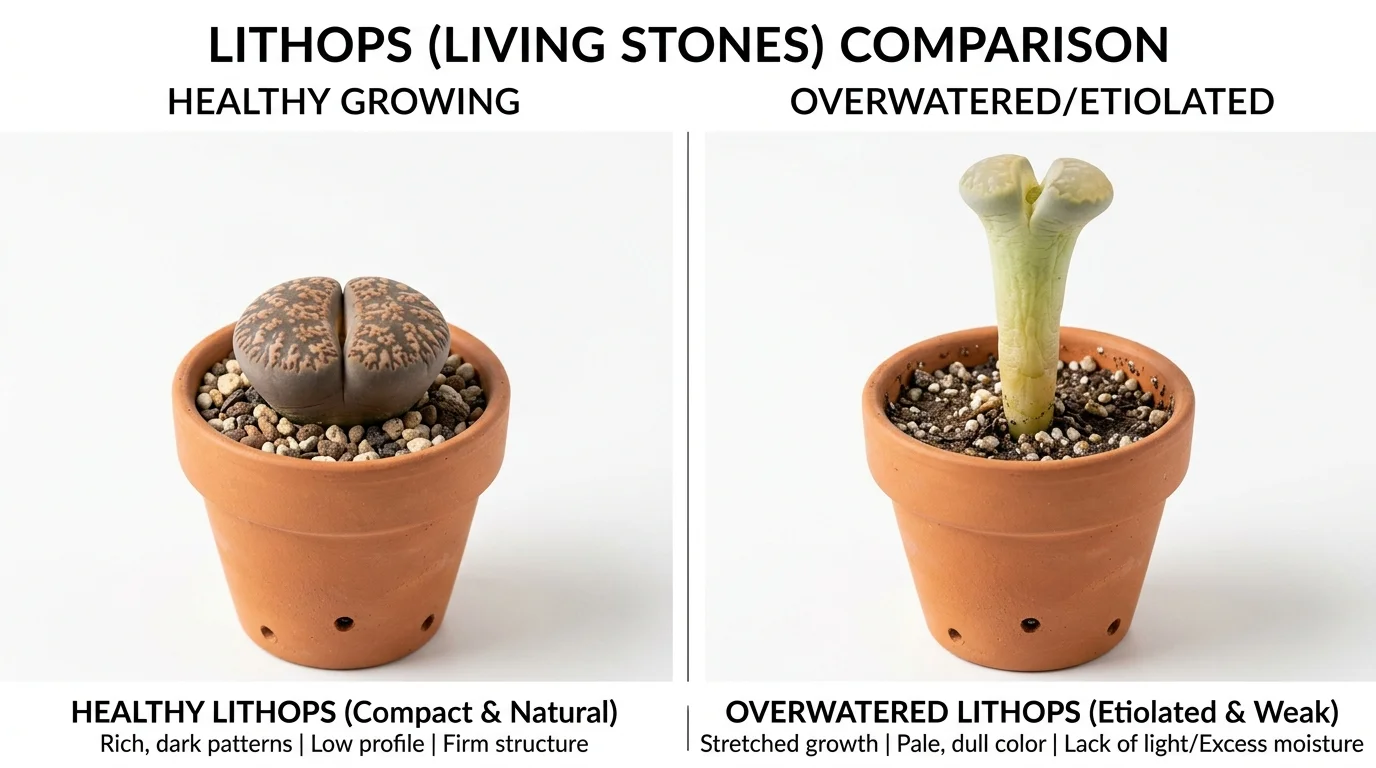
Insufficient light is the second major cause of failure. Lithops need a minimum of five hours of direct sun per day. Without adequate light, the plants etiolate, which means they stretch upward in search of light and lose the characteristic compact shape that makes them visually striking. An etiolated lithops is also weaker and more susceptible to rot. A south or east-facing windowsill is the minimum light requirement for indoor cultivation. Outdoors in summer, full sun exposure with good air circulation produces the healthiest plants.
For growers managing multiple plant types with demanding environmental requirements, the lesson from lithops applies across many drought-adapted species. The care and patience involved in managing soil moisture for plants from arid origins connects directly to the approach needed when maintaining healthy pond environments, where the balance of conditions determines whether the system thrives or collapses. In both situations, small consistent decisions over a long period matter more than any single intervention.