
Quick answer: No, aluminum is not biodegradable. It’s an inorganic metal, so microorganisms can’t break it down the way they break down food scraps or paper. Instead, aluminum reacts slowly with oxygen and forms a thin, protective oxide layer that makes it last for centuries in a landfill. The good news is that this same chemical stability is exactly why aluminum is one of the most recyclable materials on earth. It can be melted down and reused indefinitely without losing quality.
For aluminum specifically, “biodegradable” is the wrong question to ask. The question that actually matters is: can it be recycled instead of landfilled? And for aluminum, the answer is an emphatic yes.
What Does “Biodegradable” Actually Mean? (And Why Metals Don’t Qualify)
Biodegradation is a biological process: bacteria, fungi, and other microorganisms consume organic material and break it down into simpler natural substances like water, carbon dioxide, and biomass. It’s how an apple core or a cotton shirt eventually disappears.
Aluminum doesn’t fit into that process at all. It’s a metallic element, not an organic compound, and no microorganism uses it as a food source. So by definition, aluminum cannot biodegrade: not slowly, not eventually, not ever.
That’s different from recyclable and compostable, two terms people often mix up with “biodegradable”:
| Term | What it means | Does it apply to aluminum? |
|---|---|---|
| Biodegradable | Broken down by living microorganisms into natural substances | No |
| Compostable | Biodegrades under specific composting conditions into usable compost | No |
| Recyclable | Can be collected, reprocessed, and remanufactured into new products | Yes, indefinitely |
The Aluminum Association describes aluminum as 100% recyclable, retaining its properties no matter how many times it’s reprocessed.
Expert Insight Note
Aluminum’s non-biodegradability and its infinite recyclability come from the same root cause. It’s chemically stable and doesn’t break down into something else. That stability is a liability in a landfill and an asset in a recycling stream.
If It Doesn’t Biodegrade, What Happens to Aluminum Over Time?
Aluminum doesn’t just sit there unchanged forever, either. When exposed to air and moisture, it reacts with oxygen to form aluminum oxide (Al₂O₃), a thin, hard film that spontaneously stops growing at around 2 nanometers thick.
This is where aluminum behaves very differently from a metal like iron. Iron rust flakes off, exposing fresh metal underneath to keep corroding. Aluminum oxide does the opposite: it forms a dense, tightly adhering “passivation layer” that seals the surface and self-limits further corrosion.
That’s an important distinction to make clearly:
Oxidation/corrosion = a chemical reaction with oxygen that forms a protective surface layer
Biodegradation = a biological process carried out by living organisms
Aluminum oxidizes. It does not biodegrade. Conflating the two is one of the most common mistakes in articles on this topic.
How Long Does Aluminum Take to Decompose in a Landfill?
This is one of the most searched follow-up questions, and one where a lot of sources online disagree with each other, often without citing anything.
Figures you’ll commonly see quoted range anywhere from 50 years to 500 years, with plenty of variation in between depending on the site. Most of these numbers circulate widely across blogs with no traceable original study, so treat any single figure with caution rather than as settled fact.
What corrosion science actually supports: measured atmospheric corrosion rates for aluminum run around 1.5 micrometers per year in typical urban exposure, often less. Given that a can wall is roughly 0.1 to 0.15 mm thick, simple depth math places full corrosion-driven breakdown on the order of centuries, with painted or coated aluminum lasting even longer.
An important complication: modern landfills are engineered to inhibit decomposition of almost everything, aluminum included. The FTC itself notes that landfills, incinerators, and recycling facilities don’t provide the conditions needed for complete decomposition within a year, for any material. So even organic matter that would biodegrade quickly in nature can persist for decades once sealed in a landfill.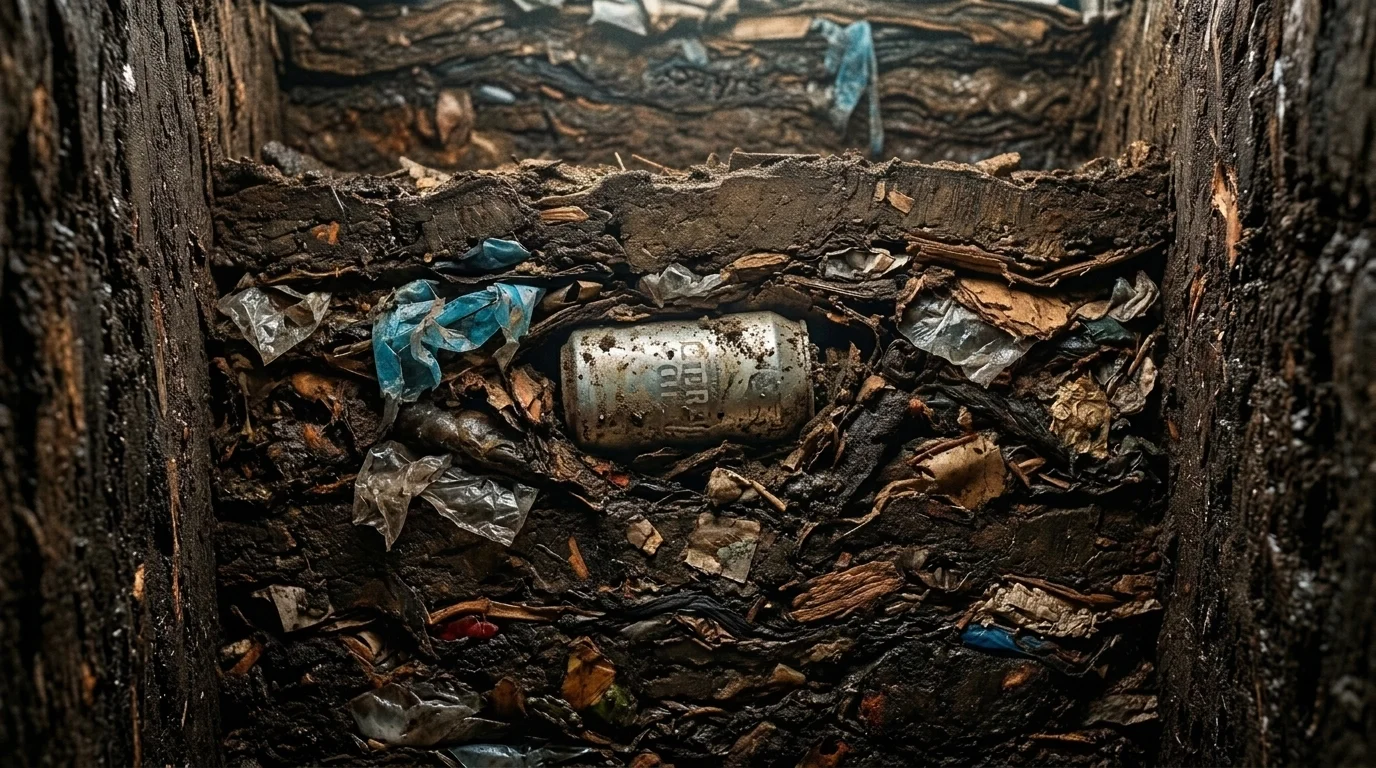
The honest takeaway: there’s no single, universally agreed-upon number for how long aluminum takes to “decompose.” What’s well established is that it persists on the order of centuries, effectively permanent on a human timescale, which is precisely why recycling it, rather than landfilling it, is the meaningful action.
Are Aluminum Cans Biodegradable?
No. Aluminum cans don’t biodegrade for the same reason raw aluminum doesn’t: they’re made of an inorganic metal.
But cans are also the best-case scenario for aluminum’s other defining trait: recyclability.
Globally, aluminum beverage cans reached a 75% recycling rate in 2023, ahead of PET plastic bottles (47%) and glass bottles (42%).
In the United States, the aluminum can recycling rate was 43% in 2023, below the historical average of roughly 52% since tracking began in 1990, though still well ahead of glass (39.6%) and PET plastic bottles (20.0%).
The US industry-wide aluminum recycling rate was around 57% in 2023, with can-to-can “closed loop” circularity reaching 96.7%.
EPA’s most recent detailed figures (2018 data) put the recycling rate for aluminum beer and soft-drink cans at 50.4%, and aluminum packaging overall at 34.9%.
NOTE:
These figures come from different organizations, different years, and different scopes (cans only vs. all aluminum packaging; “consumer” rate vs. “industry” rate). Always check which rate and source is being cited before comparing numbers across articles.
Recycling aluminum also uses roughly 95% less energy than producing new aluminum from raw ore, cutting associated greenhouse gas emissions by an estimated 96.6% globally. And remarkably, nearly 75% of all aluminum ever produced is still in use today somewhere in the economy.
Bottom line: an aluminum can won’t biodegrade whether it’s recycled or landfilled. The difference is that recycling turns it into a new product within weeks, while landfilling leaves it inert for centuries.
Does Aluminum Foil Biodegrade?
No, and it’s not compostable either, despite sometimes being lumped in with kitchen scraps in people’s minds.
Foil is, however, recyclable, with two caveats:
It needs to be reasonably clean. Food residue and grease can contaminate a recycling batch, so rinse or wipe foil before recycling it.
Not every municipal program accepts it. Check local guidelines. The FTC’s own marketing guidance states that an unqualified “recyclable” claim should generally only be made if recycling facilities are available to at least 60 percent of consumers where the product is sold.
A quick way to tell real aluminum foil from metallized plastic film (like some snack-bag liners, which are mostly plastic with a microscopically thin metal coating and aren’t recyclable as metal): scrunch it into a ball. Genuine aluminum foil stays crumpled; metallized plastic film tends to spring back open.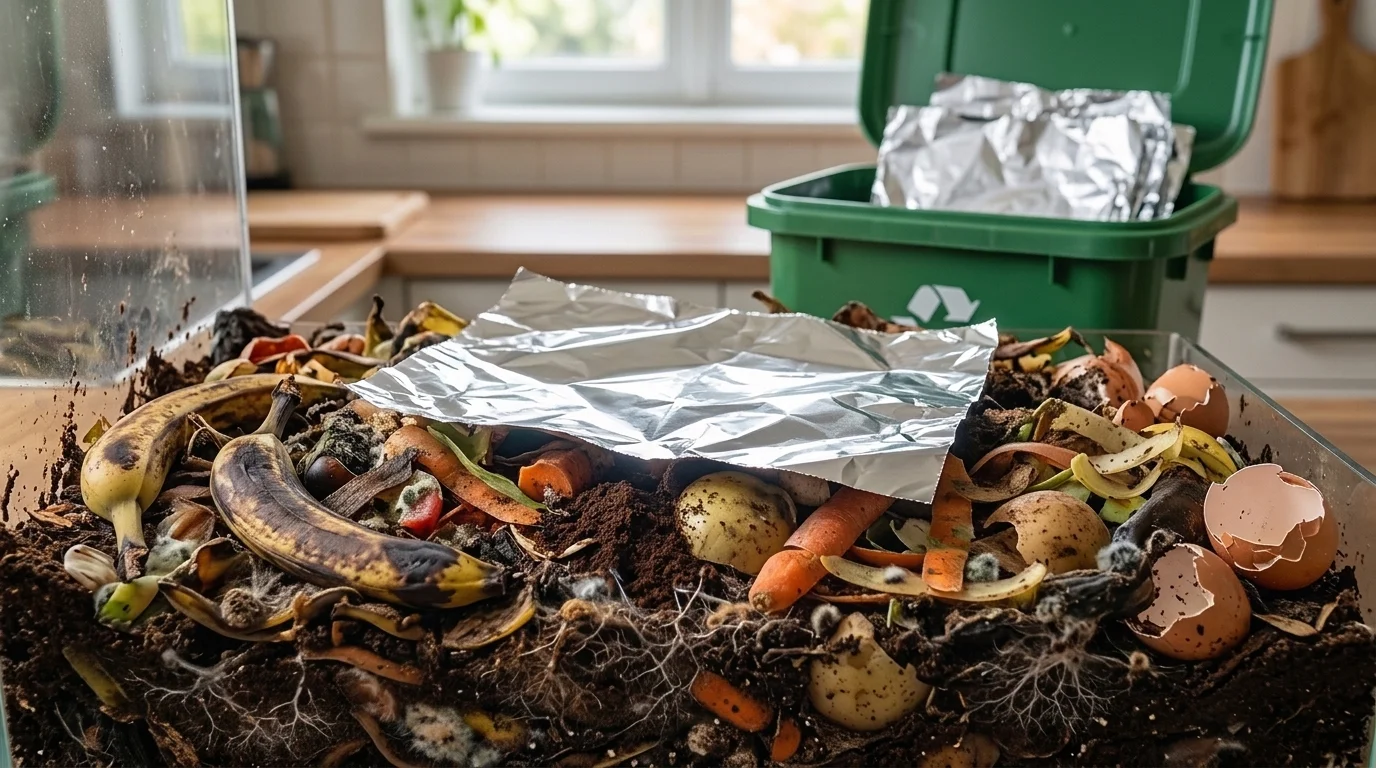
Do Aluminum Radiant Barriers Biodegrade?
No, the aluminum layer in a radiant barrier doesn’t biodegrade, for the same fundamental reason as foil and cans.
A radiant barrier is a reflective insulation product, typically installed in attics, that reflects radiant heat rather than absorbing it. It’s usually made from a highly reflective material, commonly aluminum foil facing an air space.
Here’s the nuance most articles miss: most commercial radiant barrier products aren’t pure aluminum foil. They’re laminates: a thin aluminum layer bonded to a backing material such as kraft paper, plastic film, or plastic bubble insulation. Some “metallized” reflective products use only a very thin vapor-deposited aluminum coating over a plastic film, meaning the product is mostly plastic by weight, not metal.
That construction matters for disposal:
The aluminum component itself won’t biodegrade, exactly like foil or can stock.
Because the metal is bonded to other materials, laminated radiant barriers generally can’t go into standard curbside metal recycling. Separating the aluminum from its backing isn’t practical at a household level.
In practice, most radiant barrier waste (installation scraps, old material removed during renovation) ends up as general construction debris rather than recycled metal.
A note on sourcing here: documentation on radiant barrier composition and performance is solid, but there isn’t a dedicated government source that states disposal rates for this product category specifically. The disposal conclusion above is reasoned from how the material is built, not a cited statistic, so treat it as informed guidance rather than an official figure.
Is Aluminum Better or Worse for the Environment Than Plastic?
There’s no single winner. It depends on what’s being measured.
Where aluminum has an advantage:
It can be recycled indefinitely without degrading in quality, unlike most plastics, which typically degrade in quality with each recycling cycle.
It doesn’t shed microplastics.
Recycled aluminum has a dramatically lower energy footprint than virgin aluminum, roughly 95% less energy.
Where aluminum has a heavier footprint:
Producing virgin aluminum from bauxite ore is energy-intensive and associated with mining impacts, including habitat disruption and “red mud” waste byproduct.
Some life-cycle assessments, including industry-funded comparisons as well as independent studies, find that certain plastics have a lower cradle-to-gate carbon footprint per unit of packaging than virgin aluminum, even though plastic isn’t recycled nearly as effectively in practice.
The honest summary: recycled aluminum is one of the more environmentally favorable packaging materials available. Virgin aluminum is considerably less so. Plastic’s environmental problem is less about production emissions and more about persistence, microplastic pollution, and low real-world recycling rates. Comparing the two fairly means being specific about which aluminum (recycled vs. virgin) and which plastic you’re talking about.
Can You Legally Call Aluminum “Biodegradable”? (FTC Green Guides)
This is worth knowing if you ever see aluminum products marketed as biodegradable, because under U.S. federal guidance, that claim would likely be considered deceptive.
The Federal Trade Commission’s Green Guides state that an unqualified “biodegradable” claim requires competent scientific evidence that the entire product will completely break down and return to nature within one year after customary disposal. The guidance specifically notes that items customarily disposed of in landfills, incinerators, or recycling facilities generally can’t meet this standard, because those environments don’t provide the conditions needed for complete decomposition within a year.
Since aluminum doesn’t come close to fully breaking down within a year under any customary disposal method, an unqualified “biodegradable” label on an aluminum product would run against this guidance. It’s a useful, citable reason to distrust any packaging that markets aluminum this way.
The Bottom Line
Aluminum is not biodegradable, and it won’t become biodegradable no matter how it’s disposed of. What makes it break down slowly through oxidation also happens to make it one of the most valuable and efficient materials to recycle: repeatedly, indefinitely, and at a fraction of the energy cost of producing it new.
What to actually do with it:
Recycle aluminum cans. Check that your curbside program accepts them (most do).
Rinse and recycle clean aluminum foil; don’t compost it.
Use the scrunch test to tell real foil from metallized plastic film.
For radiant barrier or construction-related aluminum waste, check with your local waste facility, since laminated products often aren’t accepted as standard metal recycling.
Skip the landfill wait. Aluminum’s real environmental story isn’t about decomposition. It’s about how effectively it gets reused.