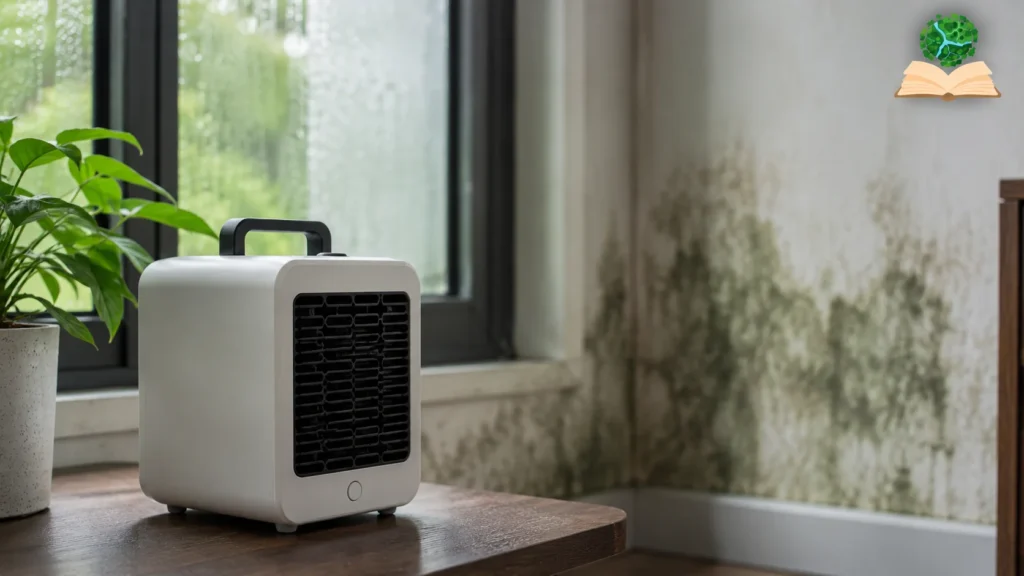

If you have ever searched for a quick fix to a mold problem, you have probably run into ozone generators. They are marketed as a kind of miracle machine, something you switch on, leave a room, and come back to fresh, mold free air. As an environmentalist, I find this claim fascinating, because it is not entirely wrong. Ozone really can destroy mold spores. But the full story is more complicated, and once you understand the chemistry involved, you will see why most health and remediation authorities warn against using ozone this way at home.
Mold is not a small problem to begin with. Research on US housing has found that damp, mold affected conditions are present in nearly half of American homes, and a widely cited study in the journal Indoor Air estimated that around 21 percent of current asthma cases in the US, roughly 4.6 million cases, are linked to dampness and mold exposure indoors. So the stakes of getting this right are real. Let’s walk through what ozone can and cannot do, using the actual research the EPA and professional remediation standards rely on.
Table of Contents
ToggleThe Short Answer
Yes, ozone can chemically damage and inactivate mold spores. That part is genuine science, not marketing spin. But the concentration needed to do this reliably is far higher than what is safe for people to breathe, ozone cannot reach mold growing inside walls or insulation, and even a successful “kill” leaves behind dead mold material that is still allergenic. In other words, ozone is not a wrong idea, it is the wrong tool for a typical home mold problem.
How Ozone Actually Destroys a Mold Spore
To understand why ozone works at all, it helps to picture what it actually is. The oxygen we breathe is O2, two oxygen atoms bonded together in a stable pair. Ozone is O3, an unstable arrangement of three oxygen atoms that is constantly looking to shed that extra atom onto something else. The EPA describes this directly, explaining that the third oxygen atom can detach from the ozone molecule and reattach to other substances, altering their chemical makeup in the process.
That reactivity is what makes ozone such a strong oxidizer. In fact, ozone has a higher oxidation potential than chlorine or the hypochlorous acid found in household bleach, which is part of why it is so aggressive against biological material. When ozone reaches a mold spore, it attacks the fats in the spore’s outer membrane through a process called lipid peroxidation, essentially breaking down the membrane from the outside in, while also damaging proteins and enzymes the spore needs to survive.
Here is a detail I find genuinely interesting: not all mold spores are equally vulnerable. Spores with thicker, more pigmented cell walls, like Aspergillus niger, put up far more resistance than thinner, more delicate spores. This is one reason a claim like “ozone kills mold” is too simple. It depends heavily on the species of mold and, as we will get into next, the environment that mold is sitting in.
The Catch Nobody Selling You an Ozone Machine Mentions
1. The Effective Dose Is Also a Dangerous Dose
This is the heart of the issue, and it rarely makes it into ozone generator marketing. A landmark 1997 peer reviewed study published in Applied Occupational and Environmental Hygiene by Foarde, VanOsdell, and Steiber tested gas phase ozone against dried mold and bacteria in sealed chambers. The researchers found that concentrations in the range of 6 to almost 10 parts per million (ppm) were required to achieve significant kill on a glass surface.
Now compare that to what is considered safe for a person to breathe. OSHA’s permissible exposure limit for ozone in a workplace is 0.10 ppm averaged over 8 hours, and NIOSH recommends never exceeding that same 0.10 ppm at any point. NIOSH also lists 5 ppm as the concentration considered immediately dangerous to life and health.
| Measurement | Concentration |
|---|---|
| OSHA safe workplace limit (8 hour average) | 0.10 ppm |
| NIOSH immediately dangerous to life and health (IDLH) | 5 ppm |
| Ozone shown to meaningfully damage mold spores (Foarde et al., 1997) | 6 to nearly 10 ppm |
Look at that gap. The dose that starts to work against mold on a lab surface is roughly 50 to 100 times higher than the safe human exposure limit, and it sits at or above the concentration considered dangerous to life itself. This is precisely why the EPA states that ozone concentrations would need to be 5 to 10 times higher than public health standards allow before ozone could sufficiently decontaminate an occupied space, and why nobody, professional or otherwise, should be running an ozone generator at those levels while people, pets, or plants are present.
2. It Cannot Reach Where Mold Actually Lives
Mold does not just sit on the surface of a wall. It grows as a network of microscopic threads called mycelia, often reaching deep into drywall, wood framing, insulation, and carpet backing. Ozone is a gas, and gas only goes where air can freely move.
Follow up research by Foarde and Eaton found that ozone performed worse on real building material, gypsum wallboard, than it did on glass in the lab, partly because gypsum itself chemically reacts with ozone and consumes it before it can reach the spores hidden within. The EPA puts it plainly: even at high concentrations, ozone may have no effect on biological contaminants embedded in porous material such as duct lining or ceiling tiles. Your ozone machine can fill a room with gas, but it is not touching the colony growing inside your wall cavity.
3. Killing Mold Does Not Mean Cleaning Up After It
Even in the best case scenario, where ozone does reach and inactivate airborne spores, that is not the end of the story. The EPA is explicit on this point: it is necessary to clean up mold contamination, not just to kill the mold, because dead mold is still allergenic, and some dead molds are potentially toxic. A room full of dead spores can still trigger allergic reactions and asthma symptoms. Physical removal, not just chemical inactivation, is the step that actually protects your health.
4. Ozone Creates Its Own Pollution
Here is something that rarely gets discussed. Ozone does not just disappear harmlessly. Indoor air chemistry research from recent years has shown that ozone reacts with common household compounds, particularly the terpenes found in citrus and pine scented cleaning products, air fresheners, and even skin oils, to form secondary pollutants like formaldehyde and ultrafine particles. One study that measured particle counts in real homes running ozone generating air purifiers found a measurable increase in fine and ultrafine particles, especially when a pine oil cleaner was also in use.
On top of that, ozone’s reactivity is not selective. It also degrades rubber, makes certain plastics brittle, fades fabric and artwork, and corrodes electronic components over time. You are not just treating your mold problem, you are potentially creating a new one.
What the Regulators and Standards Actually Say
I think it is worth being very direct here, because the guidance from every relevant authority points the same direction. The EPA states outright that no agency of the federal government has approved ozone generating devices for use in occupied spaces, and describes their effectiveness at safe concentrations as generally ineffective.
California has gone a step further. Under a state regulation, indoor air cleaning devices sold or shipped into California must be certified by the California Air Resources Board and cannot emit more than 0.050 ppm of ozone, which is why you will often see ozone generators listed as unable to ship to California addresses. CARB’s own guidance recommends against using ozone generators except for approved industrial purposes where no people are present.
The mold remediation industry has followed the same logic. The most recent update to the ANSI and IICRC S520 standard, the primary professional reference for mold remediation in the United States, advises that ozone gas and similar antimicrobial devices should not be relied upon as a primary remediation tool, placing the emphasis squarely on physical source removal instead.
Let’s Bust a Few Persistent Myths
Myth 1: Ozone is a natural, chemical free way to purify air. Ozone is the same molecule found in outdoor smog, and the EPA has stated there is no difference between the ozone in smog and the ozone produced by these devices. Marketing language like “activated oxygen” does not change its chemistry or its status as a lung irritant.
Myth 2: Lab studies prove ozone kills mold, so it will work in my house. Many of the dramatic kill rate studies you see cited were conducted on agar plates, essentially a moist, gel like growing medium that behaves like water. Dr. Eugene Cole, a professor of environmental health, has pointed out that mold grown on agar is not a fair comparison to mold embedded in a wall, since the agar acts like an aqueous environment that ozone can penetrate far more easily than solid building material.
Myth 3: Ozone is safe because it leaves no residue. As covered above, ozone reacts with common household compounds to generate secondary pollutants, and it degrades rubber, plastics, fabric, and electronics. Residue free does not mean consequence free.
Myth 4: If the mold is dead, the problem is solved. The EPA is clear that dead mold remains allergenic and sometimes toxic. Killing mold without removing it is like turning off a smoke alarm instead of putting out the fire.
Myth 5: Once treated with ozone, mold will not come back. Ozone has no residual effect once the generator is switched off and the gas reverts to oxygen. If the underlying moisture problem is not fixed, mold will begin regrowing within days to weeks.
What Actually Gets Rid of Mold
A real, lasting solution addresses three things: the existing mold, the airborne spores, and the moisture feeding it all.
Control the moisture first. Mold cannot establish itself without water. The EPA recommends keeping indoor humidity below 60 percent, ideally closer to 50 percent, and drying out any wet materials within 24 to 48 hours to prevent new growth from taking hold. Fixing leaks and improving ventilation solves the root cause, not just the symptom.
Physically remove contaminated material. Because dead mold is still allergenic, surface mold should be cleaned with an appropriate antimicrobial product, and heavily contaminated porous materials, like soaked drywall or insulation, usually need to be removed entirely rather than treated in place.
Use HEPA filtration for airborne spores. A true HEPA filter captures at least 99.97 percent of particles at the most penetrating particle size, which comfortably covers mold spores that typically range from about 2 to 20 microns depending on the species. Unlike ozone, HEPA filtration produces no gas byproducts and poses no risk to people in the room while it runs.
Bring in a professional for anything extensive. If you are dealing with a large area, hidden mold behind walls, or health symptoms tied to a mold exposure, a certified mold remediation professional trained to current industry standards is a safer and more effective route than any DIY chemical or gas based approach. If you are also weighing indoor air quality equipment more broadly, our breakdown of whether a home air conditioner can produce carbon monoxide covers a related set of indoor air safety questions worth understanding. And if the root issue is ongoing dampness in your home, our guide to sustainable resource use practices has useful groundwork on managing moisture and resources responsibly.
The Verdict
Ozone is not a scam, and it is not junk science either. It genuinely oxidizes and damages mold spores it comes into direct contact with. But the dose required to do that job is dangerously close to, or above, the concentration considered immediately dangerous to human life, it cannot reach mold hidden inside your walls, it leaves allergenic dead mold behind, and it can create new indoor air pollutants of its own. Every major authority, from the EPA to California’s air regulator to the mold remediation industry’s own professional standard, points the same direction: treat the moisture, physically remove the mold, and let HEPA filtration handle the spores in the air. That combination, not a gas generator, is what actually gets your home back to healthy.