
Quick answer: Threats to endangered species are rising worldwide, not just in a few isolated hotspots. As of October 2025, the IUCN Red List classifies 48,646 of 172,620 assessed species as threatened with extinction. The vaquita, Javan rhino, Amur leopard, all eight pangolin species, the Philippine eagle, and the axolotl are among the species facing the sharpest increases in risk, driven mainly by habitat loss, poaching, climate change, and pollution.
Table of Contents
ToggleWhat Is Causing a Worldwide Hike in Threats to Endangered Species?
If you searched for “what endangered species face word hike,” you likely meant worldwide hike, and the correction points to something real. This is not a localized crisis confined to one reserve or one country. It is a converging, accelerating phenomenon playing out on every continent and in every ocean at once.
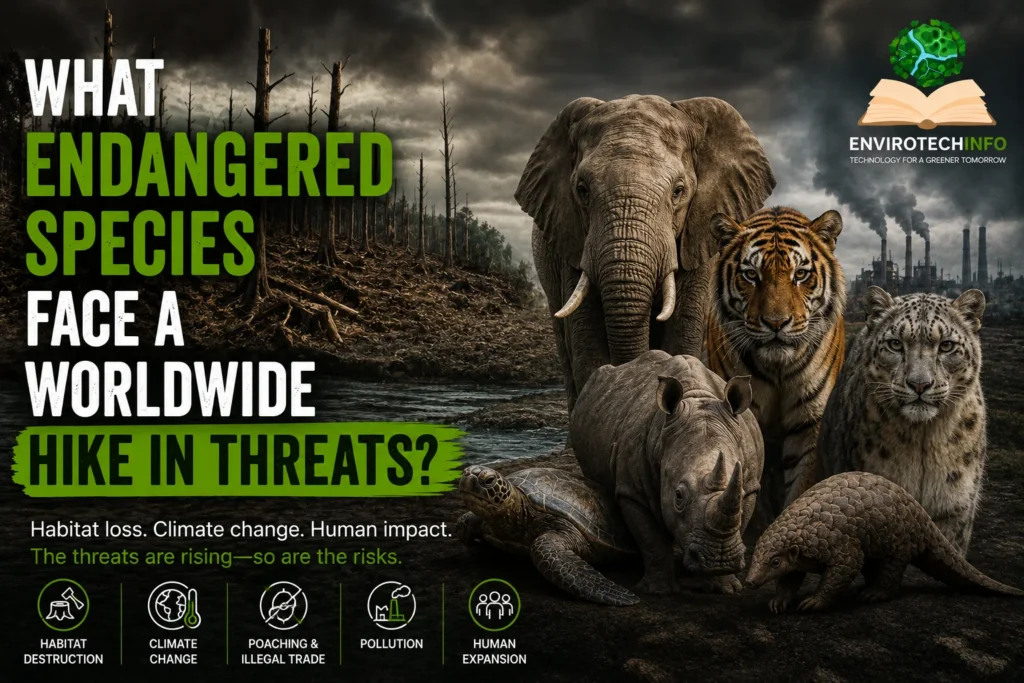
The Intergovernmental Science-Policy Platform on Biodiversity and Ecosystem Services (IPBES) ranks the direct drivers of this decline in order of global impact:
- Changes in land and sea use. The conversion of forests, wetlands, and coastlines into farmland, logging concessions, aquaculture, and urban development remains the single largest driver of biodiversity loss worldwide.
- Direct exploitation of organisms. Overfishing, overhunting, and the illegal wildlife trade are pushing entire taxonomic groups toward collapse.
- Climate change. A pervasive and accelerating force, shifting species ranges, disrupting breeding cycles, bleaching coral reefs, and melting the sea ice that species from vaquitas to Arctic seals depend on.
- Pollution. Agricultural runoff, industrial chemicals, and plastic waste are contaminating rivers, wetlands, and oceans.
- Invasive alien species. Introduced predators, competitors, and pathogens are out-competing or consuming native wildlife that has no evolved defense against them.
Disease has increasingly emerged as an additional, cross-cutting pressure, visible in the fungal pathogens driving global amphibian decline and in illnesses transmitted from humans to great apes at the edges of shrinking habitat.
How Many Species Are Threatened With Extinction Right Now?
As of the IUCN Red List’s October 2025 update, released at the IUCN World Conservation Congress in Abu Dhabi, 172,620 species have been formally assessed worldwide, and 48,646 of them are classified as threatened with extinction. The same update found that 61% of the world’s bird species now have declining populations, up sharply from 44% in 2016, and it moved three Arctic seal species closer to extinction as vanishing sea ice strips them of the platforms they need to breed and raise pups: the hooded seal moved from Vulnerable to Endangered, while the bearded seal and harp seal both moved from Least Concern to Near Threatened.
Behind these figures sits a larger, and frequently misquoted, estimate. The 2019 IPBES Global Assessment, compiled by 145 expert authors from 50 countries drawing on roughly 15,000 sources, concluded that around one million animal and plant species are threatened with extinction, many within decades. That number is a statistical extrapolation across all described and undescribed life, built partly from the roughly 25% average threat level found among assessed vertebrate and plant groups and a tentative estimate for the poorly studied insect world. It is not a headcount of individually assessed species. That figure is the IUCN’s 48,646. Both numbers are accurate; they answer different questions.
It is equally important to note what IPBES did not say. The assessment’s own chair testified before the US Congress in 2019 that even losing every one of the roughly one million threatened species would not bring the planet close to the accepted scientific threshold for a “mass extinction,” which requires the loss of at least 75% of species. What the data do show, without ambiguity, is that current extinction rates run tens to hundreds of times higher than the average background rate observed over the past ten million years, and that the average abundance of native species across most major land-based habitats has fallen by at least 20% since 1900.
Flagship Species at a Glance
| Species | IUCN Status | Current Population | Primary Threat |
|---|---|---|---|
| Vaquita | Critically Endangered | 7 to 10 (2025 survey) | Illegal gillnet bycatch |
| Javan rhino | Critically Endangered | Officially near 76 to 82; conservation groups estimate fewer after 2019 to 2023 poaching | Poaching, single-site risk |
| Amur leopard | Critically Endangered | About 130, increasing | Habitat fragmentation, poaching |
| Pangolins (8 species) | Critically Endangered to Vulnerable, depending on species | Unknown precise totals; all declining | Illegal trafficking for scales |
| Philippine eagle | Critically Endangered | About 784 mature individuals (392 pairs) | Deforestation, shooting |
| Axolotl | Critically Endangered | 50 to 1,000 wild adults | Urban pollution, invasive fish |
| Mountain gorilla | Endangered | About 1,063, increasing | Habitat encroachment, disease |
| European eel | Critically Endangered | Recruitment far below historical baseline | Dams, overfishing, trafficking |
Which Species Are Closest to the Brink?
How many vaquitas are left in 2026?
The vaquita (Phocoena sinus), a small porpoise found only in Mexico’s northern Gulf of California, remains the world’s most endangered marine mammal. The 1997 range-wide survey estimated 567 individuals. By 2024, a joint survey by Sea Shepherd, Mexico’s environment ministry, and independent scientists recorded only 6 to 8 individuals, with no calves confirmed, the lowest count on record. The 2025 survey, conducted between May and September, brought the first cautiously encouraging signal in years: researchers documented 7 to 10 individuals, including 1 to 2 calves, and reported more than a 90 percent reduction in gillnetting activity within the vaquita’s core “Zero Tolerance Area” following the deployment of concrete anti-net blocks.
A methodological note matters here. Since 2019, these are minimum counts of visually distinct individuals within a small survey zone, determined through expert elicitation, not a range-wide abundance estimate directly comparable to the 1997 baseline. A full abundance estimate from the 2025 survey is expected later in 2026 and will be the first real test of whether recent enforcement gains reflect a sustained trend.
The vaquita’s threat has never been complicated: entanglement in illegal gillnets set not for vaquitas but for the totoaba, another endangered fish whose swim bladder commands enormous prices on black markets driven by demand in parts of Asia. Despite two decades of bans, naval patrols, and net-removal operations, that illegal fishery has continued, and it remains the sole reason the vaquita may not survive this decade.
Is the Javan rhino population really recovering?
The Javan rhino (Rhinoceros sondaicus) has long been cited as one of conservation’s slow, incremental successes, a population that crept from the low seventies toward the low eighties over several decades, confined entirely to Ujung Kulon National Park on the western tip of Java, Indonesia. That narrative needs a serious caveat. Investigations and court testimony made public in 2024 revealed that two organized poaching gangs killed as many as 26 rhinos inside the park between 2019 and 2023, close to a third of the official population, while authorities were still reporting growth. The ringleader, Sunendi, received a 12-year prison sentence from the Pandeglang District Court in June 2024, along with a substantial fine, and 13 members of the two gangs have been arrested.
The Indonesian government’s official population figure has remained in the range of 72 to 82 individuals, while the conservation group Auriga Nusantara has argued the true number may be considerably lower once unreported poaching losses are accounted for, with some estimates closer to 50. This gap between official and independent figures should be treated as an open question rather than a settled fact, and any single number should be attributed to its source.
Three new calves were documented by camera trap in 2025, a genuinely hopeful sign for a species this small. But the Javan rhino’s core vulnerability has not changed: it survives in a single population, in a single park, on a coastline within reach of the volcanically active Anak Krakatau, meaning one tsunami, disease outbreak, or renewed poaching wave could threaten the entire species at once. An invasive palm species continues to spread through the park’s understory, crowding out the rhino’s natural forage.
Is the Amur leopard population increasing?
Yes, and it is one of the clearer conservation success stories among large carnivores, even though the species remains formally Critically Endangered. The Amur leopard (Panthera pardus orientalis), the world’s rarest big cat, has climbed from roughly 25 to 30 individuals in the 1970s through the 2000s to approximately 130 today.
A Wildlife Conservation Society and WildCats Conservation Alliance camera-trap study, conducted in early 2024 and published in 2025, documented a density of 1.86 leopards per 100 square kilometers within Land of the Leopard National Park in Russia’s Far East, a 183% increase since 2015, identifying 28 distinct individuals (up from 16 in 2015) from nearly 9,000 camera-trap images. The gains are real, but so are the constraints. The leopard’s range remains fragmented by roads, logging, and development. Poaching for pelts continues. Prey species like roe deer remain depressed in parts of the range. And signs of inbreeding, including kinked tails and unusually pale paws, persist as a legacy of the population’s earlier bottleneck.
Which Other Species Face Rising Threats Beyond Rhinos and Big Cats?
A worldwide hike in threats does not confine itself to rhinos, big cats, and marine mammals. It runs across every branch of the tree of life.
Pangolins remain, collectively, the world’s most trafficked wild mammals. All eight recognized species are threatened, though status varies: the Chinese and Sunda pangolins are Critically Endangered; the Indian and Philippine pangolins are Endangered; and among the four African species, the white-bellied and giant ground pangolins were uplisted to Endangered in a 2019 reassessment, while Temminck’s ground pangolin and the black-bellied pangolin remain Vulnerable. More than one million pangolins were illegally traded between 2000 and 2013, and enforcement operations seized products from more than half a million pangolins across 75 countries between 2016 and 2024 alone. All eight species have been listed on CITES Appendix I, the strictest tier, prohibiting international commercial trade, since January 2, 2017, yet trafficking persists at scale.
The Philippine eagle (Pithecophaga jefferyi), one of the largest eagles on Earth, is estimated at 392 breeding pairs, or roughly 784 mature individuals, according to a 2023 study by Sutton and colleagues. A genomic study published in 2026, conducted under the Philippine Eagle Foundation’s breeding program, found exceptionally low genome-wide genetic diversity in the remaining population, an additional layer of vulnerability on top of severe habitat loss. Deforestation across Mindanao, Samar, Leyte, and Luzon remains the primary threat, compounded by shooting, with airgun injuries among the leading causes of eagles brought into rehabilitation. Only about 32% of the eagle’s estimated remaining habitat currently falls within a formally protected area.
The axolotl (Ambystoma mexicanum), the Mexican salamander famous for its ability to regenerate limbs, illustrates what conservationists call a genuine paradox: over a million individuals exist in laboratories and the aquarium trade worldwide, while the wild population, confined to the shrinking canal network of Lake Xochimilco in Mexico City, has collapsed to somewhere between 50 and 1,000 adults per the most recent IUCN assessment. Density fell from roughly 6,000 individuals per square kilometer in 1998 to about 35 per square kilometer by the mid-2010s, and a 2024 survey of 115 sites across the protected wetland area found no axolotls through netting, though environmental DNA sampling confirmed the species is still present. Urban expansion, wastewater pollution, and invasive carp and tilapia that prey on eggs and larvae are the principal threats.
New Zealand’s kakapo, a flightless, nocturnal parrot, offers real encouragement. From a low of just 51 birds in 1995, intensive management has brought the population to roughly 236 adults heading into the 2026 breeding season, which produced at least 95 chicks, the biggest breeding season on record, surpassing the previous best of 73 fledglings in 2019. The species remains critically endangered, constrained by introduced predators, disease susceptibility, and the low genetic diversity that comes with such a severe historical bottleneck.
The California condor (Gymnogyps californianus) follows a similar arc. From a low of just 22 birds in 1982, when the entire species existed only in captivity, the total population (wild and captive) reached 607 by the end of 2025, with 392 birds flying free in the wild. Lead poisoning, from fragments of ammunition left in carrion the birds scavenge, remains the leading identifiable cause of death and the central obstacle to full recovery.
Amphibians are now the most threatened class of vertebrates on the planet. The second Global Amphibian Assessment, published in Nature in October 2023 by Luedtke and colleagues, evaluated 8,011 species and found that 40.7 percent, roughly 3,260 species, are globally threatened, driven by habitat loss, the chytrid fungal disease that has devastated frog populations worldwide, and climate change.
Insects have not been spared. The rusty-patched bumble bee (Bombus affinis) became the first bumblebee species listed as endangered in the continental United States in 2017, having disappeared from an estimated 87 to 90 percent of its historic range; the IUCN classified it Critically Endangered in 2015. The migratory monarch butterfly’s status has genuinely shifted under scientific scrutiny: the IUCN listed it as Endangered in July 2022, then downlisted it to Vulnerable in 2023 after a formal challenge found the original assessment’s models too precautionary. What is not in dispute is the scale of the underlying decline. The western North American population fell from millions of individuals in the 1980s to a record low of 1,914 counted in the 2020 Western Monarch Thanksgiving count. The US Fish and Wildlife Service proposed listing the species as “threatened” under the Endangered Species Act in December 2024, and that proposal has not yet been finalized.
Plants remain the most under-appreciated dimension of the crisis. Malawi’s national tree, the Mulanje cedar (Widdringtonia whytei), endemic to a single mountain massif, is Critically Endangered and was declared the first African tree species considered commercially extinct in 2018. Estimates of the number of remaining mature, reproducing trees vary between sources, and range from a small handful to a few dozen; the exact figure should be verified against the current IUCN assessment page before it is cited precisely. The tree is threatened by illegal logging, altered fire regimes, invasive pine plantations, and aphid infestations. Zoomed out, cycads are considered the single most threatened major group of organisms on Earth, with roughly two-thirds to just over 70 percent of assessed species threatened depending on the source, and the Royal Botanic Gardens, Kew estimated in a 2023 report that around 45 percent of the world’s flowering plant species may be threatened with extinction, a model-based estimate rather than a species-by-species Red List count.
Freshwater ecosystems are collapsing quietly. The European eel (Anguilla anguilla), Critically Endangered since 2008, has seen its recruitment of young eels into European rivers fall to a small fraction of its 1960 to 1979 baseline, according to the International Council for the Exploration of the Sea, driven by dams blocking migration routes, overfishing, trafficking of juvenile eels, pollution, and shifting ocean currents affecting larval transport. This is not an isolated case. The European Red List of Freshwater Fishes, published by the IUCN and the European Commission, found that 42.1 percent of the continent’s 558 native freshwater fish species are now threatened with extinction, with an additional 17.5 percent classified as Near Threatened, and identified dams and other river barriers as a major factor affecting the majority of assessed species.
Africa’s mountain gorilla (Gorilla beringei beringei) stands out as one of the true bright spots among great apes, the only one whose population is currently increasing. Numbering approximately 1,063 individuals across the Virunga Massif (about 604) and the Bwindi-Sarambwe ecosystem (about 459), the subspecies was downlisted from Critically Endangered to Endangered in 2018, a milestone attributed to decades of intensive, community-integrated conservation. Threats have not disappeared: habitat encroachment at the forest edge, disease transmitted from humans given the gorillas’ genetic proximity to us, snares set for other game that injure or kill gorillas incidentally, and civil unrest, particularly in the Democratic Republic of Congo sector of the range, remain live risks.
Why Does Losing One Species Affect an Entire Ecosystem?
Endangered species are rarely isolated data points. Many function as keystone species, organisms whose presence or absence reshapes the entire ecosystem around them, and the sea otter offers the clearest illustration.
Sea otters prey on sea urchins, and in doing so prevent urchins from overgrazing kelp forests into barren rock. A 2024 study in Nature found that sea otters also slow the erosion of California’s salt marshes by preying on burrowing shore crabs that would otherwise destabilize marsh banks, with erosion slowing dramatically in creeks where otters were most active. A 2020 study in Science found that a recovering sea otter population produces meaningful net-positive benefits across the wider ecosystem, including gains in finfish stocks, carbon sequestration, and ecotourism revenue that, in economic terms, outweigh the losses otters impose on local shellfish fisheries. Long-term monitoring at different coastal sites also suggests the strength of this cascade is not identical everywhere; it can play out faster in some locations and more gradually in others, depending on local conditions.
The broader lesson holds regardless of location. Removing a single well-connected species rarely produces a single, isolated loss. It produces a cascade, sometimes fast and dramatic, sometimes slow and uneven, that can restructure an ecosystem for decades.
How Big Is the Illegal Wildlife Trade?
The 2024 edition of the United Nations Office on Drugs and Crime’s World Wildlife Crime Report, its third and most current comprehensive global accounting, found that wildlife trafficking affects an estimated 4,000 species across 162 countries and territories, roughly 3,250 of which are listed under CITES. Analyzing more than 140,000 seizure records, the report tallied approximately 13 million individual items, totaling more than 16,000 tonnes, seized between 2015 and 2021. By trade value, rhino horn accounts for roughly 29 percent of the illegal wildlife trade in animals, pangolin scales for 28 percent, and elephant ivory for 15 percent. About 40 percent of the 1,652 vertebrate species identified in these seizures are themselves classified as threatened or Near Threatened on the IUCN Red List, meaning the illegal trade is disproportionately targeting species that are already in decline.
The report’s overall conclusion is sobering: despite two decades of coordinated international enforcement effort, trafficking persists, even as there are measurable signs of progress in reducing demand and supply specifically for elephant ivory and rhino horn. CITES member states most recently convened at the 20th Conference of the Parties in Samarkand, Uzbekistan, from November 24 to December 5, 2025, the first CITES conference held in Central Asia, coinciding with the Convention’s fiftieth anniversary.
Can Endangered Species Actually Recover?
Yes, and several of the clearest data points from 2024 through 2026 show that when conservation is adequately funded, scientifically grounded, and sustained over time, species can and do recover.
The Iberian lynx (Lynx pardinus) is the standout example. In June 2024, the IUCN downlisted the species from Endangered to Vulnerable, a change the organization described as the greatest recovery of a cat species ever achieved through conservation. The population grew from just 62 mature individuals in 2001 to 648 mature individuals by 2022, with the total population, including younger animals, surpassing 2,000; the 2024 census counted 2,401 lynx across Spain and Portugal combined. The recovery rests on three pillars: restoring the European rabbit population that forms the lynx’s primary prey, restoring and connecting fragmented habitat, and a sustained program of captive breeding and translocation. The species is not out of danger. Outbreaks of rabbit disease, climate change, and vehicle collisions, which accounted for 162 of 214 recorded lynx deaths in 2024, remain significant ongoing threats.
The black-footed ferret program reached a genuine scientific milestone in 2024. Using preserved genetic material from Willa, a wild ferret that died decades ago, scientists had already produced one clone, Elizabeth Ann, in 2020. A second clone, Antonia, successfully bred and raised offspring in 2024, the first time a clone of any endangered species has reproduced for conservation purposes. This formally established Willa’s genetic line as the population’s eighth founder, meaningfully expanding the genetic diversity available to a species that had descended from just seven founders for decades.
The mountain gorilla, discussed above, and the green sea turtle, reclassified globally from Endangered to Least Concern in the same October 2025 IUCN Red List update that recorded rising threats elsewhere, round out a set of case studies proving the direction of these trends is not fixed. The IUCN attributed the turtle’s recovery to a roughly 28 percent increase in the global population since the 1970s, despite ongoing threats to some regional subpopulations.
Anti-poaching patrols supported by drones and camera-trap networks, internationally coordinated wildlife-crime enforcement under CITES, the deliberate creation of habitat corridors linking fragmented protected areas, and well-managed captive breeding and reintroduction programs are the four tools underlying nearly every recovery on this list.
How Can You Help Endangered Species?
Individual action will not, on its own, reverse a crisis of this scale, but it is not irrelevant either, particularly when it is directed at mechanisms that actually work.
Support organizations with a demonstrated track record. The World Wildlife Fund and the Wildlife Conservation Society both operate at the center of several efforts described above. WCS leads the camera-trap monitoring underpinning the Amur leopard’s recovery, and WWF co-leads the international programme supporting mountain gorilla conservation across Rwanda, Uganda, and the Democratic Republic of Congo.
Make informed consumer choices, with realistic expectations. The Marine Stewardship Council’s certification, updated to its Fisheries Standard version 3.1 in 2024, now covers roughly 1.2 million tonnes of seafood sold annually, valued at approximately 13.4 billion US dollars, and by the end of 2025 about 90 percent of US fisheries by volume carried MSC certification. It is worth noting that MSC’s own reporting shows the large majority of its income comes from logo licensing fees paid by certified fisheries, a funding model that independent reviewers and peer-reviewed research have flagged as a documented conflict of interest worth being aware of. It remains a useful signal, just not an infallible one. Forest Stewardship Council certification, covering roughly 160.7 million hectares of forest worldwide as of 2024, has stronger direct evidence behind it: a 2024 study in Nature using 1.3 million camera-trap images across logging concessions in Gabon and the Republic of Congo found FSC-certified concessions held roughly 2.7 times more large mammals over 100 kilograms than non-certified concessions, an effect most pronounced for high-priority species including the critically endangered forest elephant and the western lowland gorilla. Avoiding products derived directly from threatened wildlife, including ivory, tortoiseshell, coral, and pangolin scales, remains an unambiguous action available to every consumer.
Reduce your carbon footprint. Given climate change’s position among the top drivers identified by IPBES, everyday choices around transportation, energy use, and consumption compound into meaningful collective pressure reduction over time.
Stay informed through primary sources. The IUCN Red List (iucnredlist.org) is updated regularly and remains the single most authoritative species-level reference available to the public. On the policy side, the Convention on Biological Diversity’s Kunming-Montreal Global Biodiversity Framework, adopted in December 2022, sets a target of effectively conserving at least 30 percent of the world’s land, inland waters, and ocean by 2030, a benchmark against which national governments’ progress can be tracked.
Frequently Asked Questions
What is causing the worldwide increase in threats to endangered species?
Five interacting drivers are responsible, ranked by global impact according to IPBES: habitat and land-use change, direct overexploitation such as poaching and overfishing, climate change, pollution, and invasive species, with disease acting as an additional, growing pressure.
How many species are currently threatened with extinction?
The IUCN Red List’s October 2025 update classifies 48,646 of 172,620 formally assessed species as threatened. Separately, the IPBES Global Assessment extrapolates that roughly one million species across all of life on Earth may be at risk, a broader statistical estimate rather than a species-by-species count.
Which animal is closest to extinction right now?
The vaquita porpoise, with only 7 to 10 individuals recorded in a 2025 survey, is generally considered the animal species closest to extinction, though several others, including the Javan rhino and the Mulanje cedar tree, exist in comparably small numbers.
Can endangered species actually recover?
Yes. The Iberian lynx, mountain gorilla, California condor, green sea turtle, and Amur leopard have all shown measurable population recovery in recent years, demonstrating that sustained, well-funded conservation can reverse a species’ trajectory.
What can I personally do to help endangered species?
Support conservation organizations with strong track records, choose sustainably certified seafood and forest products, avoid products made from threatened wildlife, reduce your carbon footprint, and stay informed through primary sources like the IUCN Red List.