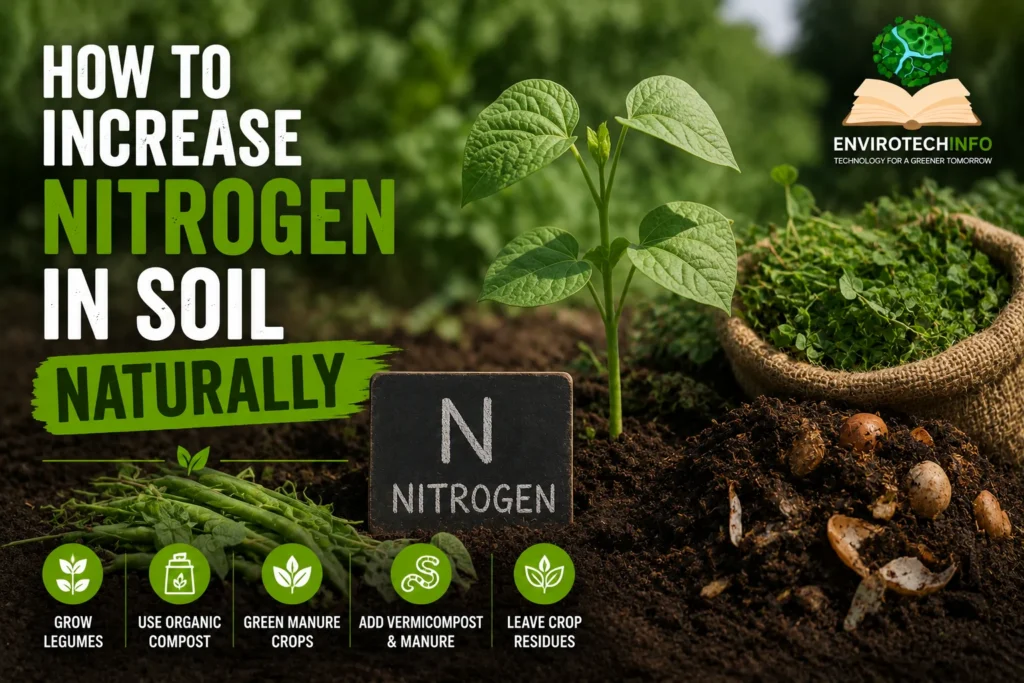

How to Increase Nitrogen in Soil Naturally: A Complete Organic Guide
Suggested meta description: Learn how to increase nitrogen in soil naturally using compost, manure, and legume cover crops, plus which plants really fix nitrogen, and when you actually have too much.
Have you ever walked through your garden and noticed one bed bursting with deep green, glossy leaves while another looks tired, pale, and stuck in place? Nine times out of ten, the difference comes down to one nutrient: nitrogen.
As an environmentalist, I think of nitrogen as the garden’s energy currency. It’s not glamorous like a flower or a fruit, but without it, nothing else happens. The good news is that you don’t need a bag of synthetic fertilizer to keep the nitrogen flowing. Nature has been doing this job for billions of years, and once you understand how, you can borrow her methods for free, without the environmental cost that comes with synthetic nitrogen runoff.
This guide walks through exactly how nitrogen naturally moves into soil, the most effective organic ways to add more of it, which plants genuinely fix nitrogen (and which ones people wrongly credit for it), how to tell if you’ve actually gone too far the other way, and why testing your soil for nitrogen usually isn’t worth your money.
Table of Contents
ToggleWhy Nitrogen Matters So Much to Your Plants
Nitrogen is a building block of chlorophyll, the pigment that lets plants capture sunlight and turn it into energy through photosynthesis. It’s also essential for making amino acids, the building blocks of proteins, which your plants use to build new leaves, stems, and roots, and it plays a role in DNA and RNA. In a healthy plant, nitrogen typically makes up somewhere between 1% and 5% of its dry weight, which tells you just how central it is to basic plant function.
When nitrogen runs short, plants show it quickly:
Yellowing of older, lower leaves first, since nitrogen is mobile inside the plant. When it’s scarce, the plant pulls it out of older leaves and redirects it to new growth.
Stunted growth and thin, weak stems
Smaller flowers and fruit than expected
Occasionally, a reddish or purplish tint on stems or the undersides of leaves
If you’re seeing these signs, your soil is asking for nitrogen. For a closer look at exactly how this shows up during a plant’s growing stages, our guide on fixing nitrogen deficiency during flowering breaks it down in more detail. For now, let’s talk about where that nitrogen actually comes from.
How Nitrogen Naturally Gets Into Soil: The Nitrogen Cycle, Simplified
Here’s something most gardening articles skip over: about 78% of the air around us is nitrogen gas (N₂). It’s everywhere, and yet plants can’t use it in that form. The two nitrogen atoms are locked together by one of the strongest bonds in nature. Getting nitrogen from the air into a form your tomato plant can actually absorb takes a process called nitrogen fixation, and it happens in a few different ways.
Biological fixation does the heavy lifting. Certain bacteria called Rhizobia live in nodules on the roots of legumes (think peas, beans, clover) in a mutually beneficial partnership: the plant feeds the bacteria sugar, and the bacteria use an enzyme called nitrogenase to convert atmospheric N₂ into ammonia the plant can use. According to the Encyclopædia Britannica, more than 90% of all nitrogen fixation on Earth happens through microorganisms like these. Beyond root-nodule bacteria, free-living microbes such as Azotobacter and Clostridium fix nitrogen in the soil on their own, without needing a legume host.
Once nitrogen is “fixed,” it still has to be processed further before plants can use it. Mineralization is the step where decomposer microbes break down organic matter (dead leaves, manure, compost) and release ammonium (NH₄⁺). Then nitrification, carried out by specialized bacteria, converts that ammonium into nitrate (NO₃⁻), the form most plants actually prefer to absorb, alongside some ammonium uptake in acidic or waterlogged soils. This whole cycle matters because it explains why nitrogen management isn’t really about “adding a nutrient” the way you’d add a vitamin. It’s about feeding an entire living system that does the converting for you.
There’s also a smaller, often-misunderstood atmospheric route. Lightning genuinely does fix nitrogen: the heat of a bolt is enough to briefly break apart N₂ molecules, which then combine with oxygen and eventually dissolve into rain as nitrate. Scientists estimate lightning fixes somewhere in the range of a few million tonnes of nitrogen globally per year, though the exact number is still debated among atmospheric researchers. This is also where the old folk wisdom about snow being “poor man’s fertilizer” comes from. Melting snow and rain do carry a small amount of dissolved nitrogen down to the soil, generally estimated at only a few pounds per acre per year in most places. It’s a real phenomenon, but not one you should rely on to feed a hungry vegetable bed. And it’s worth noting that a good portion of the nitrogen in today’s rain and snow actually comes from air pollution rather than natural lightning.
The Best Natural Ways to Add Nitrogen to Your Soil
With the science out of the way, here’s what actually works in a real garden.
1. Compost: The Steady, Reliable Foundation
Finished compost typically contains around 1-2% nitrogen by weight, released slowly as soil microbes continue to break it down. That might sound modest compared to a synthetic fertilizer, but the slow-release nature is exactly what makes it hard to overdo, and it comes bundled with organic matter that improves soil structure, water retention, and microbial life, the very system that makes nitrogen available in the first place.
How to build it: aim for roughly three parts “browns” (dried leaves, straw, shredded cardboard) to one part “greens” (grass clippings, food scraps, coffee grounds) by volume. This lands you in the ideal carbon-to-nitrogen range of about 25-30:1 for efficient decomposition. Keep the pile as damp as a wrung-out sponge and turn it every week or two. Depending on conditions, finished compost can take anywhere from two months to a year.
How to apply it: work 2-4 inches into the top 6-12 inches of soil before planting, or use 1-2 inches as a top dressing around established plants.
2. Animal Manure: Concentrated, But Handle With Care
Manure has fed soil for as long as humans have farmed. Roughly speaking, fresh chicken manure runs about 1.1% nitrogen (the strongest of the common manures), horse manure around 0.7%, and cow manure around 0.6%. Poultry manure in particular releases much of its nitrogen quickly, since a large share is already in an immediately available form.
The golden rule: always use aged or composted manure, never fresh, with the exception of rabbit manure, which is gentle enough to use in small amounts without composting. Fresh manure can burn plant roots with excess ammonia, may carry pathogens, and often introduces weed seeds. Age it for 6-12 months, or fold it into your compost pile, before it touches your garden beds.
3. Legume Cover Crops: Nature’s Living Fertilizer Factory
If you want to actually build long-term soil nitrogen rather than just topping it up season to season, this is the method with the biggest payoff. Legume cover crops such as clover, hairy vetch, field peas, and alfalfa partner with Rhizobia bacteria to pull nitrogen straight from the air and store it in their roots and tissue. When you cut them down and let them decompose in place (a method sometimes called “chop and drop”), that nitrogen becomes available to whatever you plant next.
The numbers here are genuinely impressive. USDA-SARE’s cover crop research has measured hairy vetch contributing somewhere in the neighborhood of 100 pounds of nitrogen per acre under typical conditions, with some well-managed fields reaching considerably higher. More broadly, agricultural extension services note that legume cover crops as a group can add up to roughly 300 pounds of nitrogen per acre. Clover and Austrian winter peas perform similarly well when allowed to reach flowering before being cut down.
Timing tip: cut and incorporate your cover crop right around early bloom (roughly 10-25% of plants flowering), which is when nitrogen fixation peaks. Then wait 2-4 weeks before planting your next crop in that spot. Freshly chopped legume material decomposes fast, but it needs a short window to fully release its nitrogen without temporarily tying up what’s already in the soil.
4. Grass Clippings, Blood Meal, Feather Meal, Fish Emulsion, and Alfalfa Meal
For a quicker or more targeted boost:
Grass clippings are genuinely nitrogen-rich. Mulching them back into a lawn, rather than bagging them up, can supply up to a quarter of the nitrogen a healthy lawn needs.
Blood meal (roughly 12-13% nitrogen) and fish emulsion or fish meal (around 10%) act fast, which is useful when you need a quick green-up.
Feather meal (roughly 12-15% nitrogen) releases more slowly, making it a good middle ground.
Alfalfa meal (around 2.5% nitrogen) is gentler and comes with a natural growth-stimulating compound called triacontanol as a bonus.
5. Worm Castings (Vermicompost): Small Amounts, Big Impact
Worm castings usually test out at somewhere around 1-2% nitrogen, but the real value isn’t the number on the label. What matters more is that the nitrogen arrives already processed by the worm’s gut microbes into forms plants can absorb almost immediately, alongside a thriving population of beneficial microbes and natural growth compounds. A worm bin fed on fruit and vegetable scraps, coffee grounds, and crushed eggshells (avoiding meat, dairy, and oily foods) can produce finished castings in three to six months.
Which Plants Actually Fix Nitrogen? (And Which Ones Don’t)
This is where a lot of garden advice gets muddled, so let’s be precise about it.
Genuine nitrogen fixers are legumes, plants in the pea family that host Rhizobia bacteria in their root nodules. This group includes peas, green beans, soybeans, clover, hairy vetch, alfalfa, peanuts, lentils, fava beans, and lupines. Grown as a cover crop and turned into the soil, these plants leave meaningfully more nitrogen behind than they used.
Plants that do NOT fix nitrogen, despite sometimes being lumped in by well-meaning garden blogs, include sunflowers, tomatoes, cucumbers, potatoes, roses, and corn. Sunflowers in particular are worth calling out because the myth persists: they are heavy nitrogen feeders, not fixers, and a stand of sunflowers will draw down soil nitrogen rather than add to it. If you’re growing sunflowers anyway, our guide on how to grow a field of sunflowers covers what they actually need to thrive, including their real nutrient appetite. Sweet peas (the ornamental Lathyrus odoratus, not the edible garden pea) are technically legumes but fix only minimal nitrogen, not enough to count on as a soil-building strategy.
The practical takeaway: if you want a plant to build your soil’s nitrogen, plant it for that purpose, as a cover crop you’ll chop and drop or till in, rather than assuming any green, leafy plant is doing the job.
Should You Test Your Soil for Nitrogen?
Here’s a piece of advice you won’t see on most gardening sites: skip the nitrogen test. Nitrogen is one of the most unstable nutrients to measure because nitrate doesn’t bind to soil particles the way phosphorus or potassium do. It stays dissolved in soil water and shifts constantly with rainfall, temperature, and microbial activity. A sample tested today can read completely differently in two weeks. University extension soil labs generally acknowledge this and base their nitrogen fertilizer recommendations on your soil’s organic matter percentage and what you’re growing, rather than a direct nitrogen measurement. As a rough rule of thumb, each 1% of organic matter in your soil can supply somewhere in the ballpark of half a pound to a pound of nitrogen per 1,000 square feet over a season.
What is worth testing, and stays reasonably stable, is your soil’s pH, along with phosphorus and potassium. This matters for nitrogen too: the bacteria that convert ammonium into nitrate work fastest in soil with a pH between about 7 and 8, and their activity drops off sharply in acidic soil below pH 5. Most vegetables are happiest in the 6.0-7.0 range anyway, so correcting pH does double duty: better growing conditions and a more active nitrogen cycle.
Too Much of a Good Thing: When Nitrogen Becomes a Problem
As someone who thinks about soil health in the context of the wider environment, I want to flag something that rarely gets mentioned in “add more nitrogen” articles: it’s entirely possible to overdo it, and the consequences don’t stop at your garden fence.
In the plant itself, too much nitrogen shows up as lush, dark green foliage with disappointingly few flowers or fruit, occasional leaf burn, and floppy, “leggy” growth, with all the energy going into leaves and none into producing what you actually wanted.
Beyond your garden, excess nitrogen is a genuine environmental concern. Because nitrate is so water-soluble, anything your plants don’t use tends to leach down toward groundwater or wash off into streams and rivers during rain. At scale, this is a major contributor to algal blooms and the oxygen-starved “dead zones” that form where rivers meet the sea. The Gulf of Mexico’s dead zone, driven largely by agricultural nitrogen runoff, has measured in the thousands of square miles in recent years, an area larger than some U.S. states. It’s a sobering reminder that the same nutrient that makes your basil thrive can do real damage downstream if it’s applied carelessly.
If you suspect you’ve added too much nitrogen, a few organic fixes work well:
Stop adding any more nitrogen sources for now.
Plant heavy feeders like corn, leafy greens, or brassicas to actively draw down the excess, and remove the plant tops when you harvest rather than composting them right back into the same bed.
Mix in high-carbon material such as straw, wood chips, shredded leaves, or sawdust. This temporarily ties up excess nitrogen as the carbon-hungry microbes multiply, which is normally something gardeners try to avoid, but becomes genuinely useful here.
Avoid the temptation to flush it out with heavy watering, since that just relocates the problem to the groundwater below rather than solving it.
The best strategy, of course, is prevention: build nitrogen gradually through compost and cover crops rather than reaching for a fast-acting source “just to be safe.”
Which Plants Actually Love Nitrogen-Rich Soil?
Once your soil is in good shape, it helps to know where to put that fertility to best use. Heavy nitrogen feeders, plants that reward rich soil with vigorous growth, include tomatoes, cucumbers, corn, leafy greens like lettuce and spinach, and brassicas such as broccoli and cabbage. Potatoes appreciate moderate nitrogen but can produce more leaf than tuber if it’s overdone. Roses benefit from balanced nitrogen alongside phosphorus and potassium rather than a heavy nitrogen-only feed. Save your richest soil and freshest compost for the plants that will actually put it to work.
Building Soil That Feeds Itself
Every method in this guide points toward the same underlying idea: you’re not just feeding your plants, you’re feeding the living system underneath them. Compost, cover crops, manure, and worm castings all work by supporting the bacteria and fungi that do the actual job of making nitrogen available season after season, without the runoff risk that comes with synthetic shortcuts.
That’s the real difference between reaching for a bag of fertilizer and building living soil: one is a quick fix, and the other is a legacy. Every batch of compost you turn, every cover crop you chop and drop, and every bit of manure you age properly is a small investment in soil that keeps giving back, to your garden, and to everything downstream of it.