
Most companies that made public climate commitments in the past decade took the same path. They calculated their emissions, then paid for projects elsewhere in the world to absorb an equivalent amount. A reforestation scheme in Brazil, a cookstove programme in Kenya. The logic was clean on paper. The problem is that in 2023, independent analysis found that more than 90 percent of rainforest offset credits certified by Verra, the world’s leading carbon standard, had no real climate benefit. The trees were counted, the credits were sold, but the actual reductions either never happened or were massively overstated.
This is where insetting enters.
Insetting is a sustainability strategy in which a company invests in emission reduction projects within its own value chain rather than outside it. The International Platform for Insetting, whose corporate members include Nestle, H&M Group, Chanel, Kering, and Nespresso, defines it as the actions taken by an organisation to fight climate change within its own value chain in a manner which generates multiple positive sustainable impacts. The defining phrase is within its own value chain. Where offsetting sends money to unrelated projects in distant places, insetting directs investment into the actual farms, factories, and suppliers that your business already depends on.
The practice was pioneered roughly a decade ago by Plan Vivo and PUR Projet, two organisations focused on nature-based climate solutions, though the term “insetting” itself is credited to Tom Poole of FLO-CERT, who coined it around 2010. For most of its early life insetting remained a niche concept. That changed fast. By 2025 it had moved from the margins of corporate sustainability to one of the most actively debated frameworks in climate strategy, driven by tightening regulatory pressure and the growing recognition that supply chain emissions were far larger than most companies had acknowledged.
In practical terms insetting looks different across industries but follows the same logic. A coffee company working with farmers in Ethiopia might fund the transition from chemical fertilisers to regenerative soil practices on those farms, reducing the agricultural emissions embedded in every bag it sells. A fashion brand might pay for a fabric supplier in Bangladesh to replace coal-fired boilers with electric heating. A food manufacturer might work with its dairy suppliers to implement methane-reducing feed additives. In each case the company is not paying a third party to absorb emissions somewhere abstract. It is reaching into its existing supply relationships and funding real change in the places where its actual environmental impact originates.
The business case extends beyond emissions. When a company invests in a supplier’s ability to reduce emissions, it simultaneously builds a deeper supply relationship, reduces future climate-related disruption risk, and gains greater visibility into conditions that affect both its reporting and operational continuity. Conservation International, which published high-integrity insetting principles in May 2025 with input from more than 100 individuals across 40 organisations including Environmental Defense Fund and The Nature Conservancy, noted that insetting done properly strengthens the long-term resilience of both the company and its suppliers simultaneously. Their full insetting principles and interactive supply chain dashboard are publicly available for companies looking to map climate mitigation potential across their sourcing regions.
The regulatory picture in 2026 has added urgency. The AIM Platform, counting Amazon, Dow, Patagonia, H&M Group, Netflix, and REI among its members, published its completed Version 1.0 Standard and Guidance for value chain interventions in April 2026 after two years of piloting. This is the first globally auditable framework specifically designed for insetting claims. In the same month, the GHG Protocol released its Scope 3 Standard Phase 1 Progress Update, March 2026, which for the first time formally proposes how inset credits should be treated within corporate emissions inventories. The EU’s Corporate Sustainability Reporting Directive is simultaneously requiring large European companies to report on supply chain emissions in greater detail from 2026, and California’s SB 253 requires Scope 1 and 2 disclosures in 2026 with Scope 3 following in 2027. The EU’s Empowering Consumers for the Green Transition Directive, which brings anti-greenwashing rules fully into force by September 2026, also directly affects how companies can make claims about supply chain sustainability, meaning that the informal, unverified insetting arrangements many companies relied on previously will no longer be legally defensible in European markets.
Insetting is no longer a voluntary best practice for sustainability leaders. For large companies with significant agricultural, food, or manufacturing supply chains, it is becoming the expected mechanism for addressing the emissions that offsetting was never able to credibly reach.
The Problem with Carbon Offsetting That Nobody Talks About
Carbon offsetting has failed to reliably reduce emissions across 25 years of use, according to the most comprehensive academic review of the evidence ever conducted. The premise is simple: you produce emissions, you pay for a project somewhere else to absorb the equivalent amount, and your carbon account balances. For years this arrangement went largely unquestioned. That changed decisively in 2025.
The University of Oxford and the University of Pennsylvania jointly published the most comprehensive review of carbon offsetting evidence ever conducted, examining over 970 million tonnes of carbon credits representing nearly 20 percent of all credits ever issued globally. Their conclusion was unambiguous. Carbon offsetting has been largely ineffective over 25 years, riddled with what the researchers described as intractable problems including non-additionality, impermanence, leakage, and double-counting. Non-additionality means credits are issued for projects that would have happened anyway without offset financing. The review found that only 2 percent of Clean Development Mechanism projects demonstrated a high likelihood of genuine additionality.
A separate Corporate Accountability report published in June 2025 analysed 47 of the world’s largest offset projects active in 2024 and found 43 of them problematic, together retiring 47.7 million credits, roughly 23 percent of all credits retired across the entire voluntary carbon market that year. Cookstove projects, which represent about 15 percent of voluntary market projects, showed ninefold over-crediting according to 2024 research published in Nature Sustainability. The market responded accordingly. The voluntary carbon market’s value contracted by roughly 70 percent between 2022 and 2024, according to Ecosystem Marketplace tracking. Despite billions spent on offsets, atmospheric carbon dioxide reached a record 424 parts per million in 2024 according to the World Meteorological Organization. This is not a peripheral problem. It is the structural failure that made insetting necessary.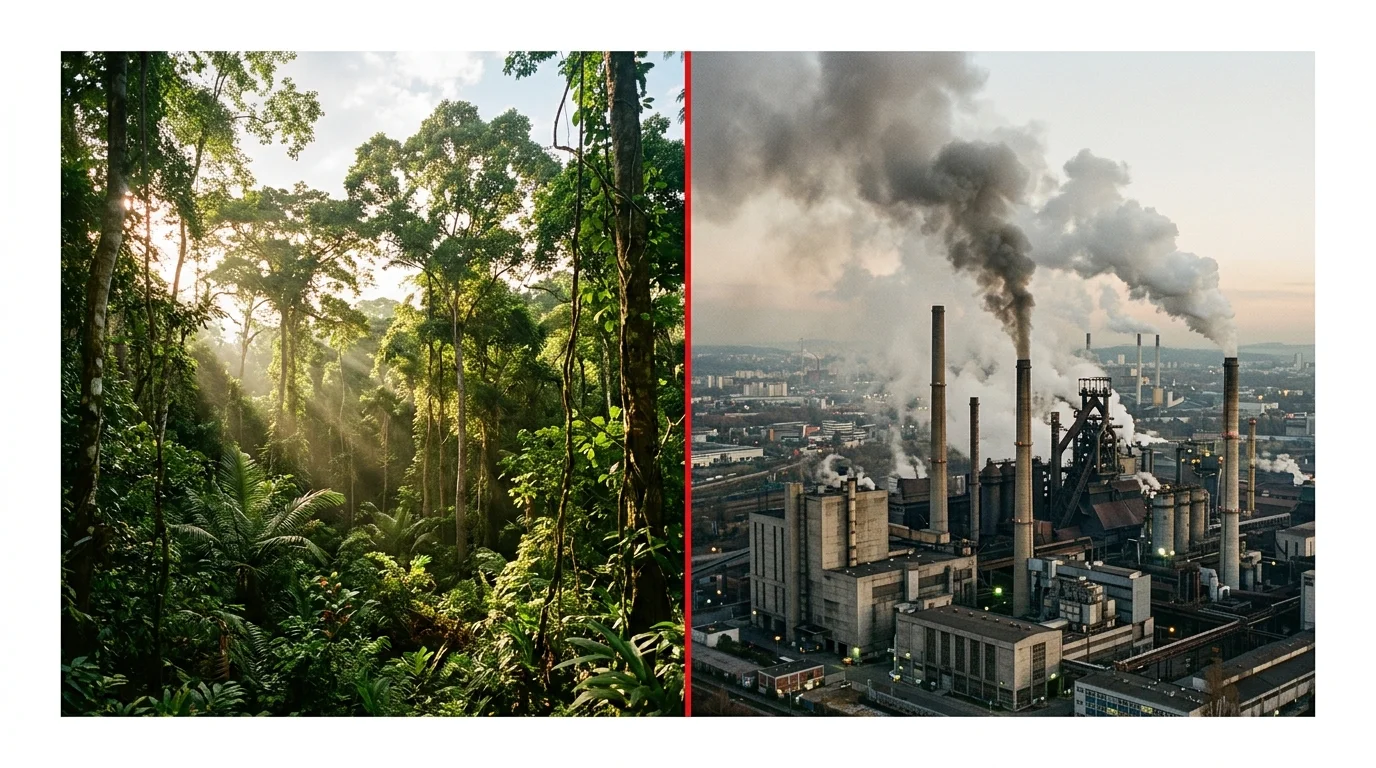
- 970 million tonnes of carbon credits reviewed by Oxford/Penn researchers, ~20% of all credits ever issued, found largely ineffective
- Only 2% of Clean Development Mechanism projects showed a high likelihood of genuine additionality
- 43 of 47 major offset projects analysed by Corporate Accountability (June 2025) were found problematic, accounting for ~23% of all VCM credits retired in 2024
- 9x over-crediting found in cookstove offset projects, roughly 15% of the voluntary market, per 2024 Nature Sustainability research
- ~70% contraction in voluntary carbon market value between 2022 and 2024
- 424 ppm — the record atmospheric CO2 level reached in 2024 (WMO)
What Insetting Actually Means in Plain English
Insetting means a company funds emission cuts at the exact point in its own supply chain where those emissions are created, instead of paying an unrelated third party elsewhere. Think of it this way. A yogurt brand does not produce its biggest emissions in its factory. It produces them on the dairy farms that supply its milk. An apparel company does not generate its heaviest footprint in its offices. It generates it in the fabric mills, dye houses, and cotton farms across its supply chain. For most companies, these upstream and downstream emissions, classified as Scope 3, represent 70 to 80 percent of their total carbon footprint.
Insetting means going directly into those supply relationships and funding the change rather than paying a stranger elsewhere to absorb the number on a spreadsheet. The yogurt brand funds advanced manure management on its dairy farms. The apparel company pays for its fabric supplier to replace coal boilers with renewable heating. The auto manufacturer co-finances a steel supplier’s switch to lower-emission production.
No external project. No distant forest. The money goes where the emissions actually come from.
Why Insetting Specifically Targets Scope 3 Emissions and Why That Matters
Insetting is built around Scope 3 because that is where most companies’ real emissions sit, and offsetting was never designed to reach it. To understand why, you first need to understand the three emission categories:
- Scope 1: Direct emissions from a company’s own operations, including fuel burned in its factories, fleet vehicles, and on-site machinery.
- Scope 2: Indirect emissions from purchased electricity. Scope 1 and Scope 2 are both within a company’s direct control and relatively straightforward to reduce.
- Scope 3: All other indirect emissions occurring upstream and downstream across the value chain, from raw material extraction through to how customers eventually dispose of the product.
According to CDP data, Scope 3 emissions account for between 70 and 90 percent of the average company’s total carbon footprint. In food, agriculture, and apparel the figure is frequently above 90 percent. A World Economic Forum analysis published in April 2026 found that only 5 percent of US companies currently report their Scope 3 emissions despite these representing the overwhelming majority of their actual climate impact.
This is precisely why insetting targets Scope 3. Offsetting can never touch it. You cannot compensate for supply chain emissions by planting trees in an unrelated country. The Science Based Targets initiative, under its Corporate Net Zero Standard, requires any company where Scope 3 exceeds 40 percent of total emissions to set an explicit Scope 3 reduction target. Given that threshold applies to virtually every company in manufacturing, food, fashion, or logistics, insetting has moved from optional to structurally necessary.
The March 2026 GHG Protocol Scope 3 progress update reinforced this by proposing clearer treatment of verified supply chain interventions within corporate emissions inventories. This marks the first time insetting has received formal accounting recognition at this level.
Insetting vs Offsetting What Is the Real Difference and When to Use Each
The core difference is location: offsetting pays for emission reductions outside your business, while insetting funds them inside your own supply chain. The structural difference between insetting and offsetting comes down to one question: does the emission reduction happen inside your supply chain or outside it?
| Factor | Offsetting | Insetting |
|---|---|---|
| Where the reduction happens | Outside the company’s own supply chain, in an unrelated project | Inside the company’s own supply chain, at the source of the emissions |
| Effect on gross emissions | Gross emissions stay the same; a credit is applied on a separate ledger | Gross Scope 3 emissions fall permanently, using a lower supplier-specific emission factor |
| Counts toward SBTi mid-term targets | No — traditional offsets are not permitted | Yes, when properly measured and verified |
| Risk if the project fails | The company’s actual climate impact was never changed, only the accounting | Reduction is embedded in operations, not dependent on a distant project’s survival |
| Best use case | Residual emissions (typically the final 5–10%) after deep decarbonisation | The bulk of Scope 3 emissions across food, apparel, agriculture, and manufacturing |
When a company offsets, it purchases credits generated by projects that have no connection to its own operations. A electronics manufacturer funds a forest conservation project in a country where it has no suppliers, no factories, no commercial presence. The manufacturer’s gross emissions stay exactly the same. The offset sits on a separate ledger as a compensatory transaction. If that forest project is later found to be fraudulent or the trees burn down, the company’s actual climate impact was never changed. It was only accounted for differently.
When a company insets, it invests directly into the supply chain that creates its products. The emission reduction happens at the source. A wheat buyer funds regenerative soil practices on the farms it sources from. The carbon intensity of that wheat then falls, and when the company calculates its Scope 3 inventory, it uses the lower supplier-specific emission factor. The reduction is permanently built into the company’s gross footprint, not applied at the end of a spreadsheet to produce a cleaner net number.
This accounting difference matters enormously under current standards. The Science Based Targets initiative does not allow companies to use traditional offsets to meet their mid-term Scope 3 reduction targets. Insetting, when properly measured and verified, supports those targets directly because it changes the actual emissions rather than compensating for them.
The two mechanisms are not always in competition. Offsetting still has a legitimate role for residual emissions that cannot be eliminated, typically the final 5 to 10 percent of a company’s footprint once deep decarbonisation has been achieved. But using offsets as a substitute for supply chain action, which was standard practice for most of the past two decades, is no longer scientifically credible or, in many jurisdictions, legally defensible.
The Three Insetting Models and How Companies Choose Between Them
Companies typically insetting through one of three models: performance-based incentives, tiered action scoring, or direct landscape transformation. The mechanics depend on how well a company knows its suppliers, how stable those supply relationships are, and how much capital it can deploy directly into the chain.
- Performance-based incentive model: The buying company embeds sustainability metrics directly into its procurement pricing. Suppliers receive no upfront capital. Instead, they earn a financial premium per unit for commodities that meet verified environmental standards, such as a bonus per litre of milk from farmers using optimised feed additives, or a higher price per kilogram of cotton grown without chemical inputs. This model works best for large, fragmented supply chains where direct asset management over individual suppliers is not realistic.
- Tiered action and scoring model: The corporation builds a standardised sustainability menu, a point-based matrix covering practices like cover cropping, installing renewable energy at processing facilities, or establishing biodiversity corridors. Suppliers accumulate points and unlock escalating rewards: extended contracts, preferred-vendor status, or financial bonuses. This model suits companies managing a diverse mix of suppliers with varying financial capacity.
- Landscape and upstream transformation model: The company bypasses incentives entirely and directly finances structural change on the ground by funding agroforestry systems, replacing coal boilers with electric heating, or restoring water basins in the regions it sources from. Nespresso, Chanel, and LVMH favour this approach because their business depends on specific geographies producing specific commodities.
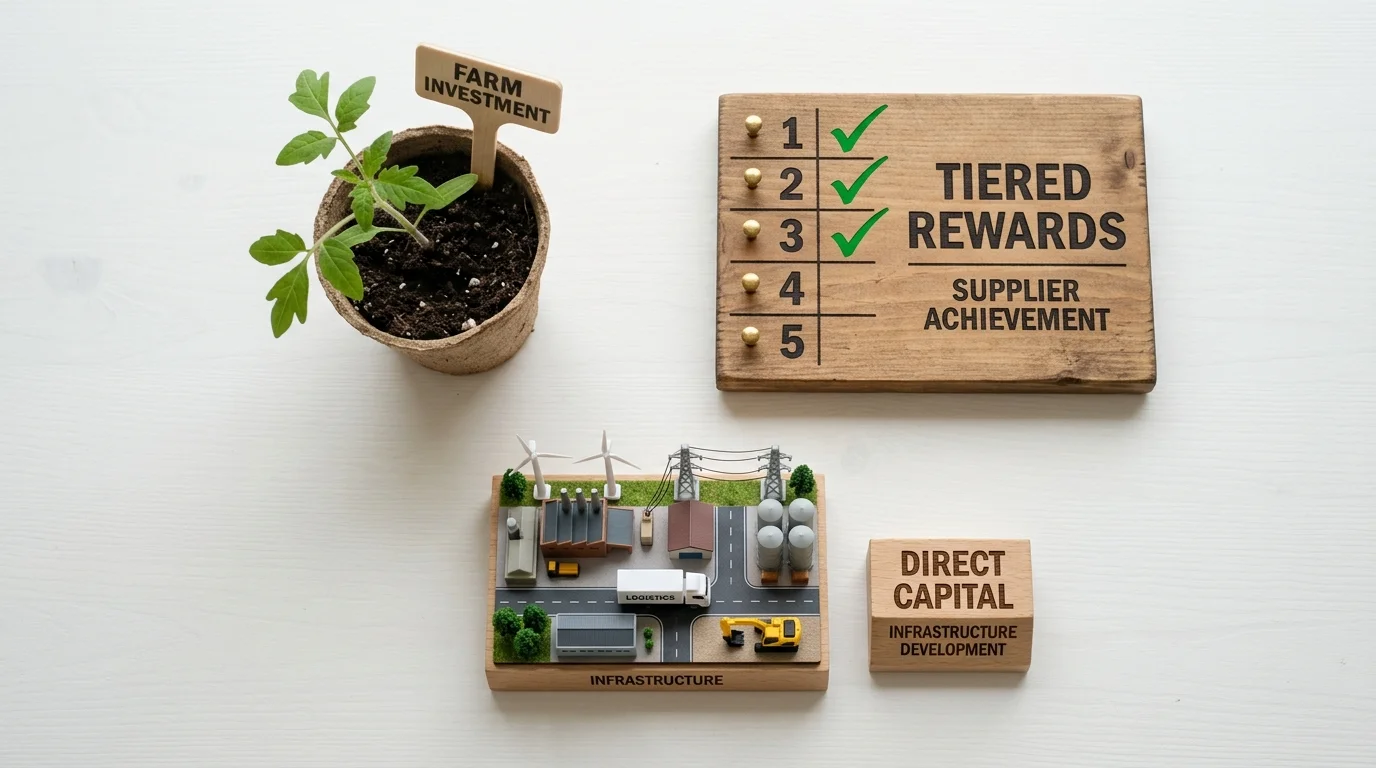
Choosing between these models comes down to four factors: how transparent the supplier relationship is, how frequently suppliers change, whether the supplier network has the data infrastructure to support monitoring and verification, and whether the company has capital expenditure available or is working within operational budgets. Most large companies end up blending all three across different parts of their supply chain.
Expert Insight Note
Most sustainability teams assume they will settle on one insetting model and scale it uniformly across their supplier base. In practice that rarely holds. A company might use performance-based incentives with large commodity suppliers where relationships are transactional, tiered scoring with mid-tier processors where some capital investment is viable, and direct landscape transformation with two or three critical strategic suppliers where supply continuity is non-negotiable. The model is not a company-wide policy. It is a supplier-by-supplier decision that should be revisited as relationships mature and data quality improves. Companies that try to apply one framework across an entire supply chain typically find it works well for 20 percent of suppliers and poorly for the rest.
Is Insetting Right for Your Business or Not
Insetting makes sense for companies with Scope 3-dominated footprints and stable supplier relationships; it becomes counterproductive for businesses sourcing from volatile spot markets. The honest answer depends on what your supply chain actually looks like.
Insetting is worth pursuing seriously when:
- Scope 3 emissions dominate your footprint, which is the case for virtually every company in food, agriculture, apparel, or consumer goods.
- You rely on specific raw materials from specific geographies. A coffee brand dependent on farms in a particular region of Ethiopia has a direct business interest in keeping those farms productive and low-carbon.
- You have established supplier relationships, meaning multi-year contracts and real visibility into Tier 1 and Tier 2 suppliers, giving you the foundation to track, verify, and report reductions credibly.
Insetting becomes difficult or counterproductive when:
- Your procurement runs through commodity spot markets where suppliers change every quarter based on price, leaving no stable relationship to build a reduction programme on.
- Your raw materials are blended at regional hubs before they reach you, making it extremely difficult to trace emissions back to a specific farm or facility, and exposing any claims you make under the EU’s anti-greenwashing rules taking effect from September 2026.
- Your organisation lacks dedicated capital budgets and the operational capacity to manage multi-year supplier programmes, meaning the overhead of running a genuine insetting initiative will outpace its benefits.
The practical test is straightforward. If you can name your key suppliers, measure their emissions, and maintain those relationships over several years, insetting is worth pursuing seriously. If you cannot do those three things yet, building that infrastructure comes first.
How Real Companies Are Using Insetting Right Now
H&M Group, PepsiCo, Starbucks, Walmart, and Heidelberg Materials have all moved insetting from pilot programme to core procurement practice. Across apparel, food, retail, and heavy industry, major brands have embedded value chain investment into their operations rather than buying credits elsewhere.
H&M Group tackled one of apparel’s most stubborn problems directly. The fashion industry’s biggest Scope 3 liability is not retail operations but the coal-fired energy running textile factories across Asia. Rather than purchasing offsets to balance those emissions on paper, H&M Group has supported the phase-out of over 100 coal-fired boilers across its supplier factories since 2022, replacing them with electric heating systems connected to renewable grids. The carbon intensity of the fabrics entering H&M’s supply chain fell as a direct result, and suppliers gained protection from volatile fossil fuel pricing at the same time.
PepsiCo and Starbucks both targeted the ground their products grow in. PepsiCo works directly with farmers and fertiliser manufacturers to transition toward low-emission inputs and regenerative practices including cover cropping across its agricultural supply base. Starbucks funds agroforestry systems within its coffee sourcing regions, providing capital for farmers to plant shade trees alongside coffee crops. Both approaches sequester carbon inside the companies’ own sourcing footprint, improve soil water retention, reduce dependence on chemical inputs, and protect yields against drought and temperature stress.
Walmart took a different approach suited to a retailer with thousands of small and mid-sized suppliers. Through Project Gigaton, Walmart partnered with financial institutions including HSBC to offer preferential financing to vendors that adopt science-based emission targets. The programme also aggregates the collective purchasing power of Walmart’s supplier base to facilitate renewable energy procurement at a scale no individual small supplier could access independently. Smaller vendors get affordable capital and clean energy structures. Walmart gets verified carbon reductions embedded across the products on its shelves.
Heidelberg Materials demonstrates that insetting is not confined to consumer goods or agriculture. The company reduced the carbon intensity of its cement by replacing traditional clinker with industrial byproducts and calcined clay in its manufacturing formulations, including a large-scale flash calciner for clay in Ghana. Because cement is a foundational material across construction and infrastructure, every tonne of lower-carbon cement sold transfers a direct Scope 3 reduction to the buyers downstream.
What connects these cases is that none of them relied on buying credits elsewhere. The reductions happened inside the supply chain, which is precisely where the emissions were coming from.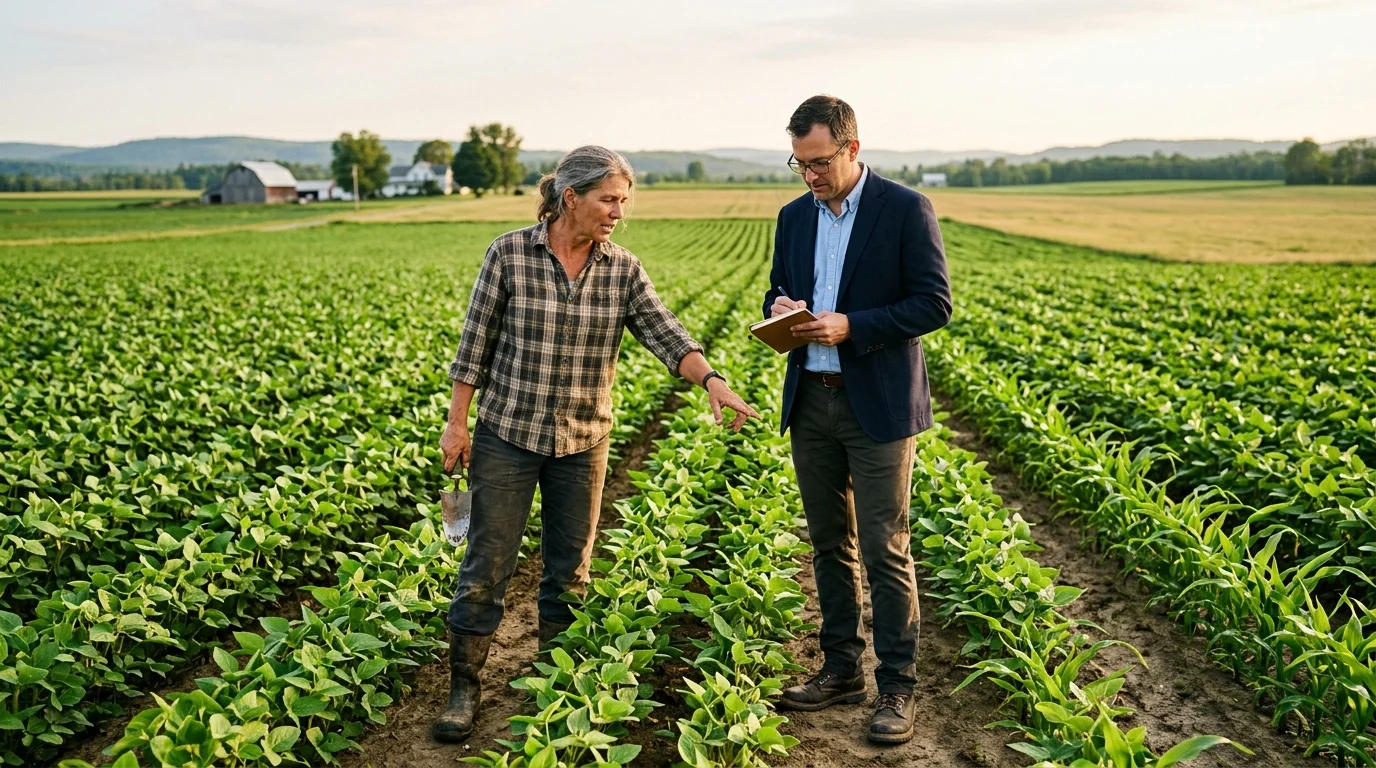
Why Insetting Is Still Hard to Do Properly and What Gets in the Way
Three obstacles stand between a corporate insetting commitment and a verified emission reduction: traceability, data availability, and regulatory double-counting risk. Most insetting programmes underestimate all three.
- Traceability: Modern commodity supply chains are built on blending. When wheat leaves a farm, soy leaves a harvest point, or copper leaves a mine, it enters regional silos and processing hubs where it is mixed with material from dozens of other sources. A company can fund regenerative farming practices on a specific set of farms, but by the time that crop reaches its factory, it has been combined with conventionally grown material at an aggregation point where physical traceability is gone. According to the Rocky Mountain Institute, over 40 percent of global greenhouse gas emissions are tied to these complex industrial supply chains, which are typically five and a half times larger than a business’s own direct assets. Book-and-claim systems and supply shed frameworks exist as workarounds, but verifying that a digital registry purchase genuinely corresponds to physical sourcing from a specific region remains an ongoing audit problem with no clean solution.
- Data availability: Insetting requires accurate baseline emissions data from the suppliers you are trying to change. That data rarely exists in usable form. A 2021 Boston Consulting Group survey found that only 9 percent of global corporations could comprehensively measure their emissions across all scopes, a figure that had fallen further to just 7 percent by 2025. The same 2021 survey found that 86 percent of companies still managed their baseline carbon data in spreadsheets rather than integrated accounting systems. Beyond Tier 1 suppliers, the visibility gap widens further, and without primary field data, a supplier that genuinely cuts its emissions may never appear as a reduction on the buying company’s ledger at all.
- Regulatory fragmentation and double-counting risk: Because Scope 3 boundaries overlap by design, one company’s indirect emissions are another company’s direct emissions. If a retailer funds an efficiency upgrade at a shared supplier facility, multiple downstream buyers sourcing from that same facility can each claim the same tonne of avoided carbon without any unified tracking system catching the duplication. The GHG Protocol’s ongoing Scope 3 Standard revision, with a Phase 1 progress update published in March 2026, is working to enforce stricter rules around data quality and source disaggregation. The AIM Platform’s Quality, Accounting and Reporting Standard and the Bloom Registry are both designed to issue verified intervention units with documented right-to-report status, but these infrastructures are still maturing.
What Standards Govern Insetting and How Companies Report It
Three standard-setting bodies govern insetting: the GHG Protocol, the Science Based Targets initiative, and the AIM Platform. Insetting does not have its own isolated accounting category; it sits under the broader framework of value chain interventions.
- GHG Protocol: Provides the foundational layer through its Corporate Value Chain Scope 3 Standard, which governs how companies calculate and disclose indirect emissions. For land-based interventions, its Land Sector and Removals Standard sets explicit rules for quantifying reductions and biogenic carbon removals. The March 2026 Phase 1 progress update proposed stricter data-quality requirements, pushing companies toward primary supplier-level data.
- Science Based Targets initiative (SBTi): Determines how value chain interventions count toward net-zero trajectories under its Corporate Net-Zero Standard. SBTi explicitly differentiates high-integrity value chain interventions from external offsets — offsets cannot meet mid-term Scope 3 targets, but verified insetting can, because it changes the actual emission factor rather than compensating for it on a separate ledger.
- AIM Platform: Provides the operational rulebook for verification. Its Version 1.0 Standard and Guidance, published in April 2026, uses two core tests: the Association Test, requiring proof of a genuine physical or economic connection to the supply region, and the Quality, Accounting and Reporting Standard, which governs how verified reductions are recorded and disclosed.
In practice, reporting works as follows. When a company executes a verified insetting project, the resulting reduction lowers the emission factor for that specific raw material category. The company then inputs this lower supplier-specific figure into its Scope 3 Category 1 inventory rather than using a generic industry average. The gross Scope 3 number falls at the source. This lower gross figure is then disclosed through CDP, which requires disaggregated Scope 3 data by category, through the ISSB S2 Standard for auditable climate-related financial disclosures, and through the EU’s Corporate Sustainability Reporting Directive, which requires verified supply chain impact reporting from large European companies from 2026 onward.
The 95 percent completeness threshold now embedded in the GHG Protocol’s proposed revisions means selective disclosure is no longer viable. Companies must account for nearly all of their relevant Scope 3 activities, which creates direct pressure to execute verified insetting rather than relying on estimates.
Where Insetting Is Headed and Why It Is Growing Faster Than Offsetting
Capital is moving out of offsetting and into insetting, driven by regulation, financial logic, and legal exposure — three pressures pushing in the same direction. The voluntary carbon offset market’s value contracted by roughly 70 percent between 2022 and 2024, according to Ecosystem Marketplace tracking. In the same period, the number of companies holding validated Science Based Targets grew by 40 percent, with over 10,000 organisations now holding validated targets, collectively representing more than 40 percent of total global market capitalisation.
- Regulatory pressure: Under SBTi’s Corporate Net-Zero Standard, any company where Scope 3 exceeds 40 percent of its total emissions profile must set a formal Scope 3 reduction target and achieve 90 to 95 percent gross decarbonisation across the value chain before 2050. External offsets cannot be used to meet those mid-term targets, leaving companies no structural choice but to reduce the actual emission factors of their suppliers.
- Financial logic: Offsetting is an operational expense with no return — the money leaves the business to purchase a credit from an unrelated project. Insetting is a capital investment that improves soil health, reduces input costs, stabilises yields against climate shocks, and builds supplier resilience. Nearly half of the world’s 500 largest companies have already implemented or were planning internal carbon pricing systems to fund exactly this kind of supply chain investment, according to CDP data.
- Legal exposure: The UK Advertising Standards Authority banned greenwashing campaigns from airlines including Air France-KLM, Lufthansa, and Etihad Airways in 2023, and the Financial Conduct Authority’s anti-greenwashing rule took effect in May 2024, requiring sustainability claims to be fair, clear, and not misleading. Companies are responding by moving toward contribution claims that explicitly disclose gross emissions.
Looking ahead, three developments will accelerate insetting further:
- Supply shed frameworks are emerging to allow multiple buyers sourcing from the same region to co-invest in local regenerative infrastructure and co-claim verified reductions without duplication risk.
- AI and satellite remote sensing are reducing the cost of farm-level verification, making primary data collection viable at scale.
- Insetting outcomes are being built directly into legally mandated filings under the EU’s Corporate Sustainability Reporting Directive and California’s SB 253, transforming it from a voluntary practice into an auditable financial requirement for operating in major markets.