
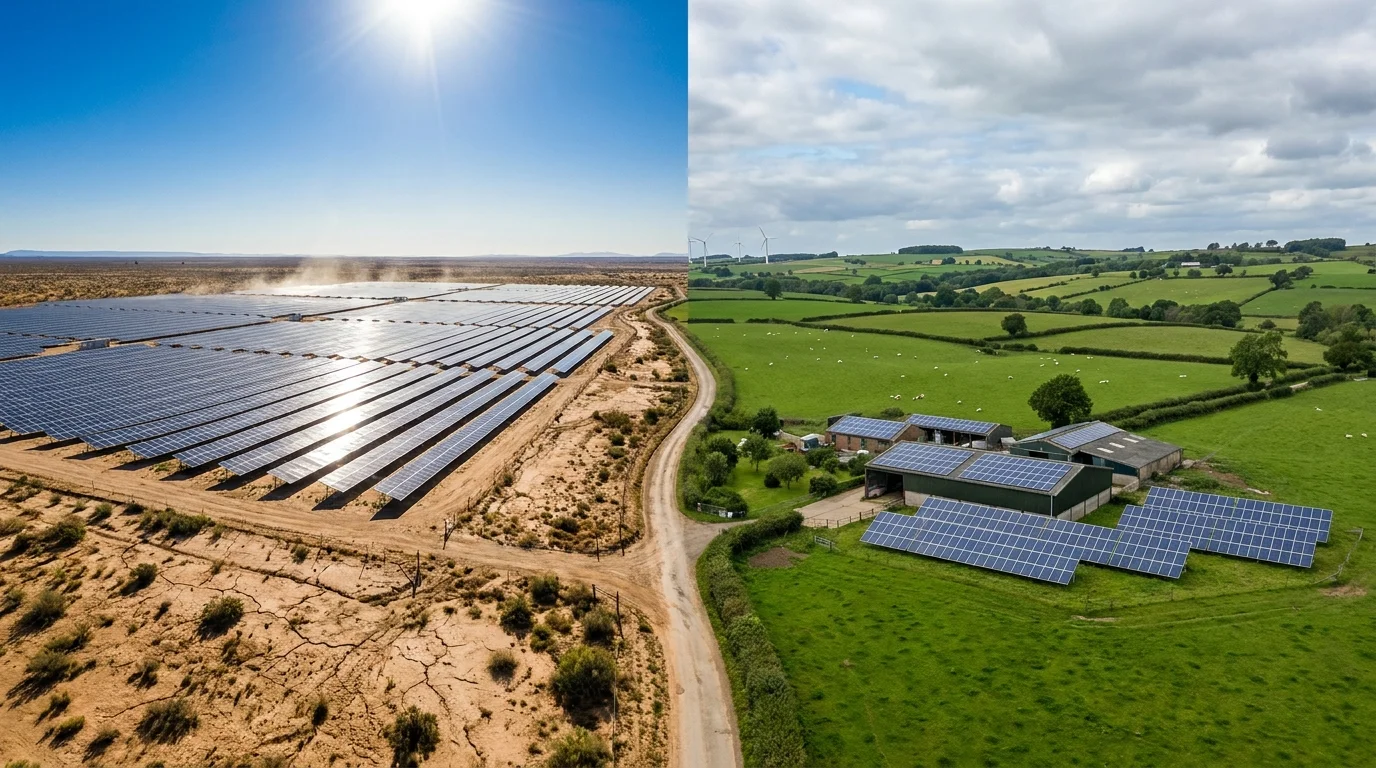
Put the exact same solar panel on a roof in Namibia and on a roof in Ireland, and you will not get the same electricity out of it. Not even close. The panel hasn’t changed, the inverter hasn’t changed, and the wiring is identical. The only thing that’s different is where on Earth it sits.
That’s really the whole story of solar efficiency and location. People tend to compare panel brands and efficiency ratings, but the place you install a system often matters more than the hardware you buy. Below, I’ll walk through each location factor in the order it actually matters, with the numbers behind it.
Quick answer: Location controls how much sunlight reaches a solar panel and how well the panel can convert it. Latitude sets the angle and length of daylight, local climate decides how often clouds block the sun, temperature affects how efficiently the cells work, and dust or air pollution can cut output further. That’s why the same system can produce almost twice as much energy in one country as in another.
The Foundation: Solar Irradiance and Sunlight Availability
Every solar calculation starts with irradiance, the amount of solar energy that lands on a surface. Think of it as the fuel supply. A panel can only convert what arrives, so a site with more irradiance will always have an advantage, no matter how good the technology is.
The U.S. Energy Information Administration explains that places at lower latitudes and in arid climates generally receive more solar energy than other locations, and its maps show the strongest resource in the southwestern United States. Globally, the gap is even clearer. A World Bank analysis of solar potential by country found that a top country like Namibia and a low one like Ireland differ by slightly less than a factor of two in practical solar output. In plain terms, a panel in the sunniest regions can produce close to double what it would in the cloudiest ones.
The good news is that most people don’t live at either extreme. The same World Bank report notes that 93 percent of the world’s population lives in places where average daily solar potential falls between 3.0 and 5.0 kWh per installed kilowatt, which is enough to make solar worthwhile almost everywhere.
Latitude and the Angle of Incidence
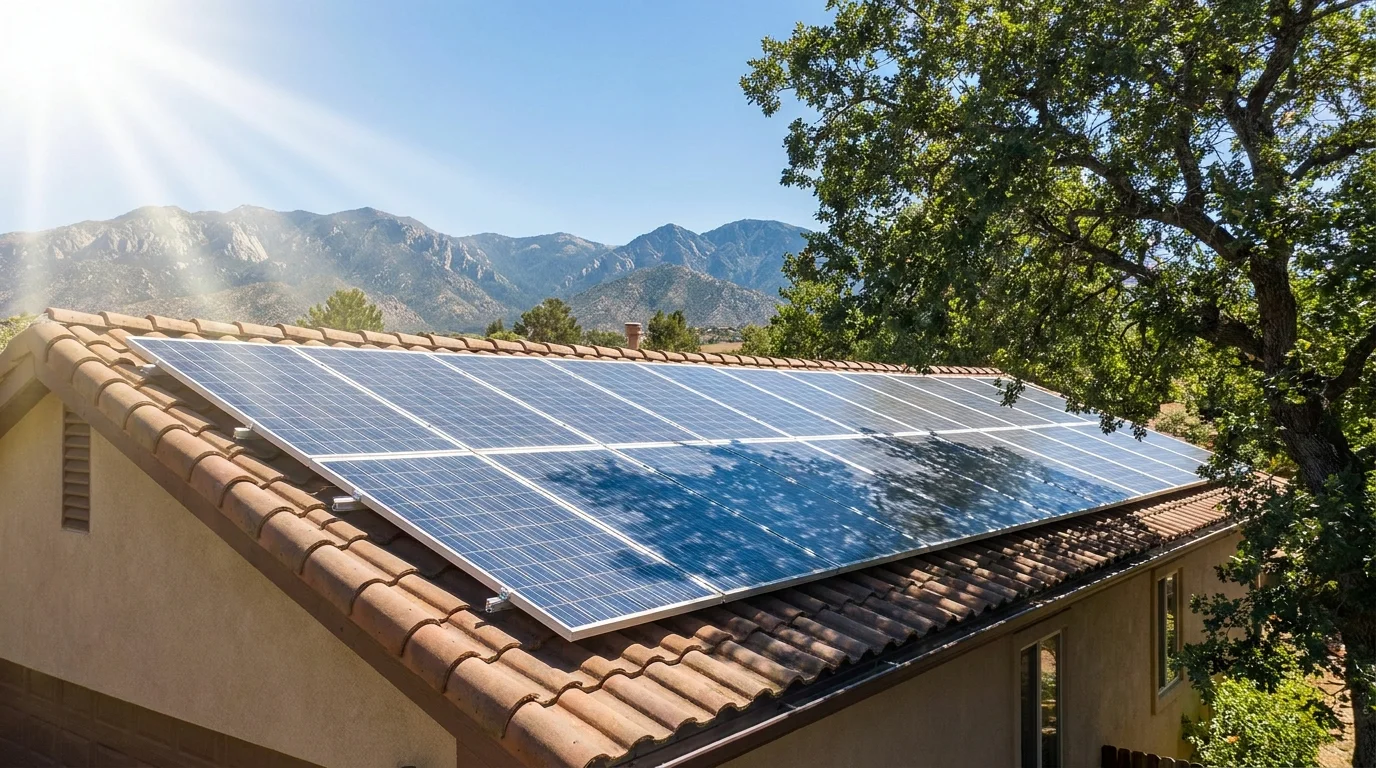
Latitude is the single biggest geographic factor. Near the equator, the midday sun sits high in the sky for most of the year, so its rays hit the ground almost straight on. Energy arriving at a steep angle is concentrated on a smaller area, which means more power per square metre.
Move toward the poles and the sun stays lower. The same beam of light spreads across a wider patch of ground and travels through more atmosphere before it gets there, losing energy along the way. That’s why a panel in Oslo, at about 59° north, gets weak, short winter days, while a panel in Nairobi, almost on the equator, sees fairly steady sunshine all year.
Higher latitudes do get one bonus: very long summer days. But the extra hours rarely make up for the weak winter months, so annual output is still lower than it is closer to the equator.
Climate, Clouds and Temperature
Clouds are the next big filter. They don’t switch a panel off, but they do scatter and absorb a lot of the incoming light. According to EnergySage, panels on a cloudy day produce roughly 10 to 25 percent of their typical output, depending on how thick the cloud cover is. Over a whole year, a cloudy coastal climate simply collects less energy than a dry inland one at the same latitude.
Still, cloudy countries are not out of the game. Germany and the United Kingdom have both built large solar sectors despite grey skies, helped by diffuse light and, in Germany’s case, strong early policy support.
Temperature surprises a lot of people. Solar cells actually work better when they’re cool. Panels are rated at 25°C, and their output drops slightly for every degree hotter they get. This is measured by the temperature coefficient. Many modern panels lose around 0.25 to 0.3 percent of output per degree Celsius above 25°C, while older or cheaper panels can lose closer to 0.5 percent, as EnergySage explains. On a hot roof, panel surfaces can reach 65°C, so a sunny desert site wins on sunlight but gives a little back to heat. A cool, clear, high-altitude site is often the best of both worlds.
Orientation, Tilt and Shading at Your Site
Even within one city, two houses can get very different results. In the Northern Hemisphere, panels facing south collect the most energy over a year, and panels in the Southern Hemisphere should face north. Facing east or west isn’t a disaster, though. EnergySage reports that an ideal east-west layout loses about 10 to 15 percent of annual production compared with a perfect south-facing system, and a typical less-than-ideal rooftop loses about 20 percent.
Tilt matters too, though less than direction. The U.S. Department of Energy guidance cited by EnergySage says south-facing panels perform best at tilts between 15 and 40 degrees, and the most productive year-round angle is usually a little flatter than your latitude. Steeper angles help catch the low winter sun.
Then there’s shading. A tree, chimney or neighbouring building that blocks the sun for part of the day can drag down the output of a whole string of panels. This is the one location factor you can often fix, by trimming branches or choosing a different part of the roof.
Altitude, Dust and Air Pollution
Altitude helps. At higher elevations there is less atmosphere above the panel to absorb and scatter sunlight, and the air is usually cooler, which keeps the cells efficient.
Air quality works the other way, and this is where solar energy and environmental policy meet. A 2017 study led by Duke University and published in Environmental Science and Technology Letters found that dust and air pollution in parts of China, India and the Arabian Peninsula cut solar output by 17 to 25 percent or more, even when panels were cleaned monthly, and by 25 to 35 percent when they were cleaned only every two months (ScienceDaily summary). Particles in the air block sunlight before it arrives, and particles that settle on the glass block it again. Cleaner air, in other words, is not just better for our lungs. It’s also better for renewable energy.
Policy and Economics: The Human Side of Location
Location isn’t only physical. Local rules decide whether a solar system pays off. Net metering, feed-in tariffs, tax credits and rebates can make solar attractive even where sunshine is only average. Germany is the classic example: its early solar boom came from pioneering feed-in tariffs rather than exceptional weather. Before installing, it’s always worth checking what incentives apply where you live, because they can shorten the payback period by several years.
The Science Class Version: Location and the Dependent Variable
If you’re here because of a school assignment, here’s how the question is usually framed. In an experiment comparing solar energy at different places, the location factors you change or compare, such as latitude, altitude or cloud cover, are the independent variables. The amount of solar energy received, or the electricity a panel produces, is the dependent variable, because it depends on those location factors.
As for which locations receive the most solar radiation per unit area, the answer is places where the sun is high overhead and the sky is clear and dry: tropical and subtropical deserts, especially at higher elevations. Regions such as North Africa, the Middle East and parts of southern Africa, Australia and Chile appear near the top of the World Bank’s rankings for this reason.
How to Check the Solar Potential of Your Own Location
You don’t have to guess. Free tools let you model output for your exact address. NREL’s PVWatts Calculator estimates annual production for sites in the United States and many other countries, and the Global Solar Atlas shows solar resource maps for the whole world. Enter your location, roof direction and tilt, and you’ll get a realistic picture before speaking to an installer.
Conclusion
Location shapes solar performance at every level, from the angle of the sun at your latitude to the clouds over your town, the heat on your roof and the dust in your air. The panel is only half of the equation. The other half is the place you put it. Understanding those factors helps homeowners set realistic expectations, helps planners choose the best sites, and reminds all of us that cleaner air and smarter policy make renewable energy work even better.