

Microplastics have been found almost everywhere scientists have looked: deep oceans, mountain snow, drinking water, food and human blood. In early 2025, a study added one of the most unsettling places yet to that list, the human brain. The headlines were alarming, but the research itself is more nuanced, and it’s worth understanding what it actually found and what it didn’t.
Quick answer: A study published in Nature Medicine in February 2025 measured micro- and nanoplastics in brain tissue from people who had died. It found that concentrations were higher than in liver and kidney samples, rose by roughly 50 percent between 2016 and 2024, and were higher in a small group of people who had dementia. The study does not prove that microplastics cause dementia or other brain diseases, and much more research is needed.
What Did the Study Find?
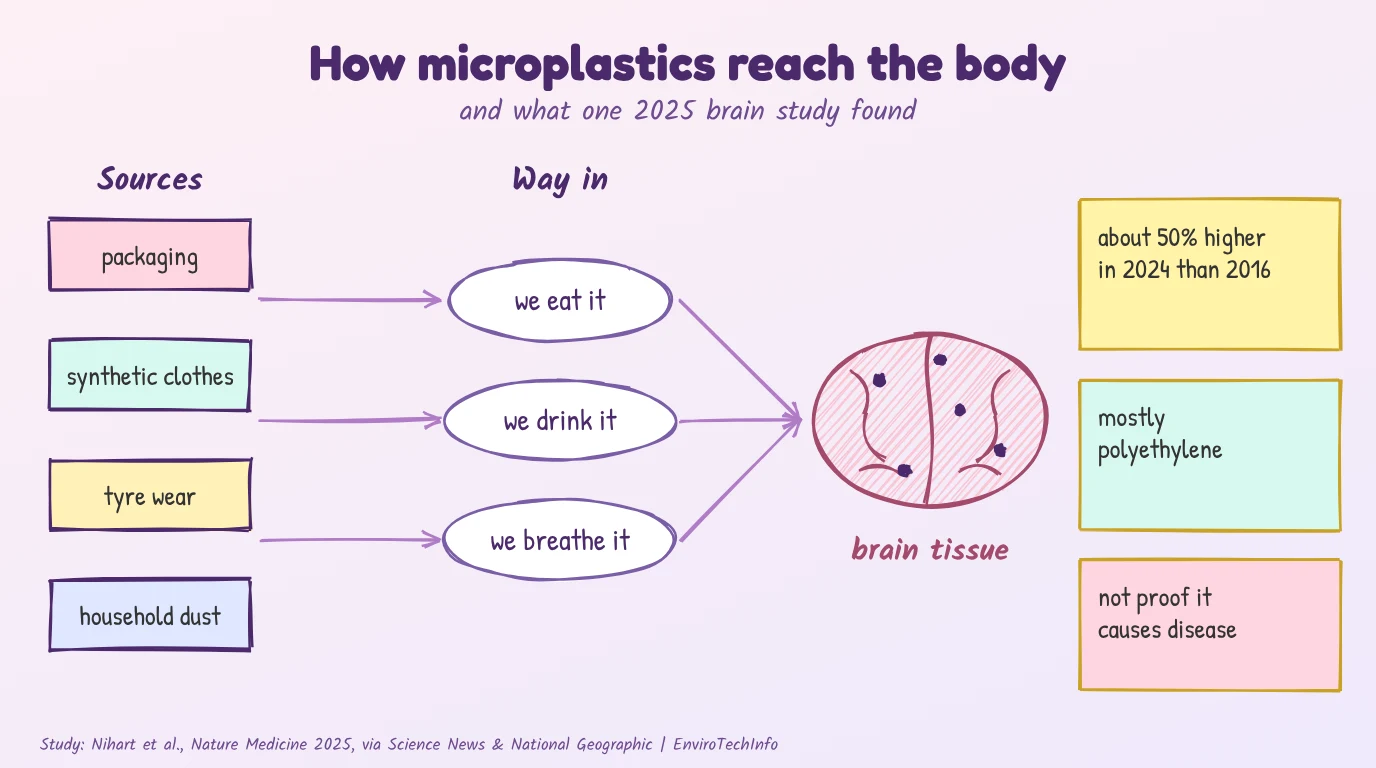
The paper, titled “Bioaccumulation of microplastics in decedent human brains” by Alexander Nihart and colleagues, was published online in Nature Medicine on 3 February 2025. The work was led by toxicologist Matthew Campen at the University of New Mexico Health Sciences, as CBS News and National Geographic reported.
The researchers analysed tissue from the frontal cortex of people who had died, along with liver and kidney samples. According to Science News, the median concentration of micro- and nanoplastics in brain samples rose from 3,345 micrograms per gram in 2016 to 4,917 micrograms per gram in 2024, an increase of roughly 50 percent. In the 2024 samples, brain levels were around 10 times higher than in liver and kidney tissue. National Geographic described the difference as about 7 to 30 times higher.
Interestingly, the person’s age at death did not appear to be linked to how much plastic was found, which suggests that recent exposure may matter more than a lifetime of accumulation.
What Kind of Plastic Was Found?
The researchers detected 12 different types of polymer, but most of the material was polyethylene, the plastic used in bags, bottles and food packaging. Many of the particles were tiny shard-like fragments at the nanoscale, under 200 nanometres long according to Science News, far smaller than a grain of sand and small enough to move through the body in ways larger particles cannot.
The Dementia Finding, and Why It Needs Caution
The study also examined brains from a small group of 12 people who had been diagnosed with dementia. Their brains contained considerably higher levels of microplastics, with National Geographic reporting levels about three to five times higher than other samples.
This is the part of the research most likely to be misunderstood. The study was not designed to prove that microplastics cause dementia, as CBS News noted. Dementia itself may change the brain in ways that allow more particles to enter or remain, for example through damage to the blood-brain barrier or reduced clearance of waste. In other words, the relationship could run in the opposite direction.
Limitations of the Research
Science News highlighted several important limits. The sample sizes are small, especially for the dementia group. Measuring nanoplastics accurately is technically difficult, and lab contamination from plastic equipment is a constant risk. The study looked only at tissue after death, so it can’t show what happened over a person’s life or track health outcomes in living people. Reported sample numbers also differ between news reports, which is another reason to treat the exact figures as early estimates rather than final answers.
None of this makes the findings unimportant. It means they are an early warning that deserves careful follow-up, not a final verdict on health risk.
Where Do These Microplastics Come From?
Microplastics enter our bodies mainly through what we eat, drink and breathe. Plastic packaging, synthetic textiles, household dust and the breakdown of larger plastic waste in the environment all contribute. Tyre wear is another major source, as we explain in our article on tyre pressure and microplastic pollution. With most plastic waste never recycled, as covered in our guide to plastic alternatives, the amount of plastic fragmenting in the environment keeps growing.
How to Reduce Your Exposure
Scientists stress that we don’t yet know how harmful these particles are, but there are sensible steps that reduce exposure without much effort. Experts quoted by CBS News and National Geographic suggest switching from plastic water bottles to stainless steel or glass, avoiding heating food in plastic containers, using wooden or stone cutting boards instead of plastic ones, cutting back on single-use plastics, ventilating your home and vacuuming regularly to reduce plastic-laden dust, and avoiding personal care products with plastic microbeads.
Beyond personal choices, the bigger solution lies in reducing plastic production and waste at the source, which is a policy and industry challenge as much as an individual one.
Conclusion
The 2025 Nature Medicine study is one of the clearest signs yet that microplastics are reaching deep inside the human body, including the brain, and that levels may be rising. At the same time, it does not show that these particles cause disease. Until larger studies answer that question, reducing unnecessary plastic use is a reasonable, low-cost precaution for our own health and for the environment.