
Quick answer
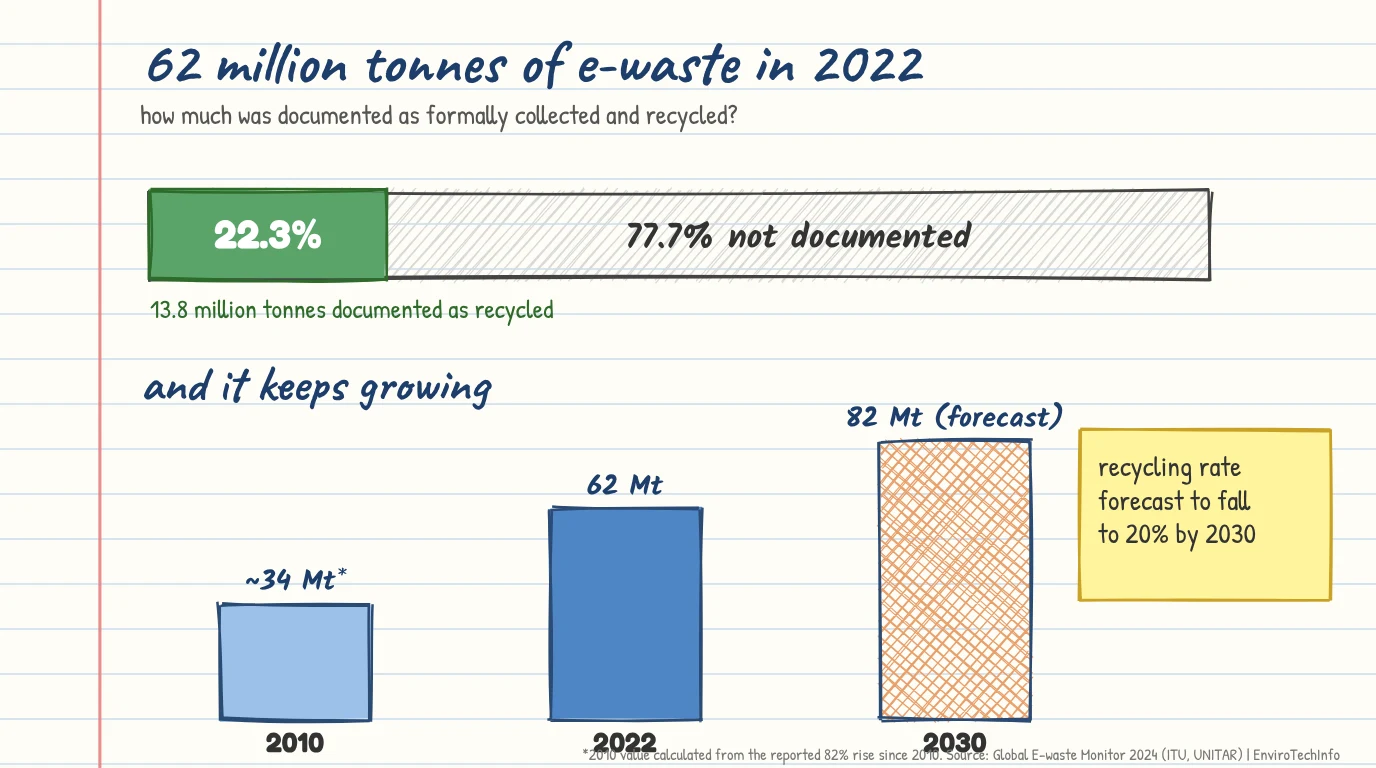
In 2022 the world threw away a record 62 million tonnes of electronics, and only 22.3% of it was documented as properly collected and recycled. E-waste is growing five times faster than documented recycling and is on track to reach 82 million tonnes by 2030 (Global E-waste Monitor 2024).
I put this page together because e-waste numbers get repeated all over the internet, often years out of date and with no source attached. Here you will find the latest figures I could verify, and every one of them links to the report it came from.
The global numbers come from the Global E-waste Monitor 2024, which is still the most recent worldwide count and covers the year 2022. European data comes from Eurostat (2024), U.S. data from the Environmental Protection Agency (its latest national year is 2018), and the health facts from the World Health Organization. Where I had to calculate or round a number myself, I say so.
Last reviewed: November 2026 by Rabia Khan, BS Environmental Sciences.
Mt = million tonnes. Source: Global E-waste Monitor 2024.
Table of Contents
ToggleHow Much E-Waste Does the World Produce?
E-waste is anything with a plug or a battery that has reached the end of its life, from phones and laptops to fridges, toys and solar panels. What struck me most while going through the latest report is not only how much of it there is, but how much simply disappears from the records once it leaves our homes.
- The world generated a record 62 million tonnes of e-waste in 2022 (Global E-waste Monitor 2024).
- That is 82% more than in 2010, and the yearly total keeps rising by about 2.6 million tonnes.
- On average, every person on Earth generated 7.8 kg of e-waste in 2022.
- Only 22.3% (13.8 million tonnes) was documented as formally collected and recycled.
- E-waste is on track to reach 82 million tonnes by 2030.
- If current trends continue, the documented recycling rate is expected to fall to 20% by 2030.
- 5.1 million tonnes of e-waste (8.2% of the global total) was shipped across borders in 2022, and about 65% of that moved from high-income to middle- and low-income countries.
Which Regions Produce the Most E-Waste?
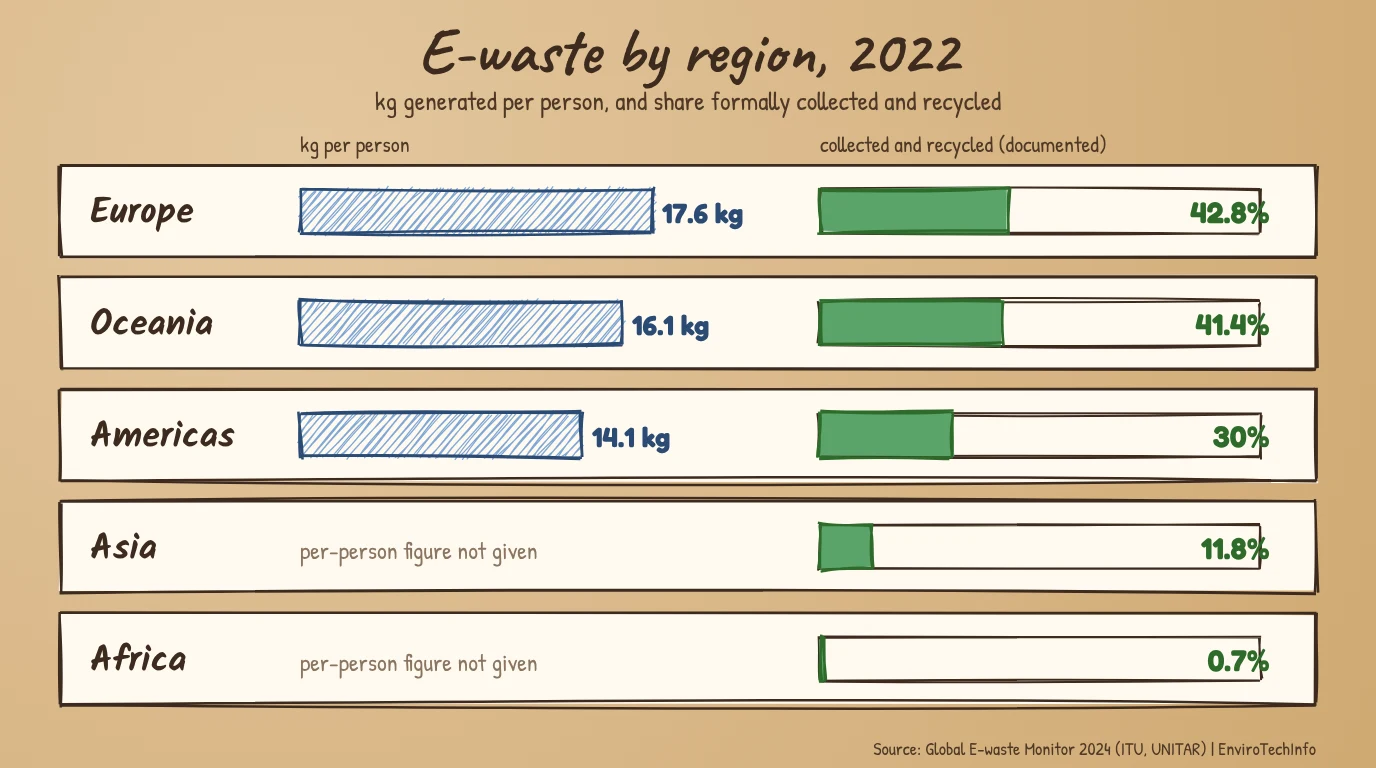
Wealthier regions throw away the most electronics per person, but they also collect and recycle more of it. In much of Asia and Africa, old devices are taken apart by informal workers, often by hand and without protective gear, and that is where many of the health problems further down this page begin.
- Europe generated the most e-waste per person in 2022 at 17.6 kg, followed by Oceania (16.1 kg) and the Americas (14.1 kg).
- Europe also had the highest documented collection and recycling rate at 42.8%, followed by Oceania (41.4%) and the Americas (30%).
- Asia generated about half of the world's e-waste in 2022, roughly 30 million tonnes.
- Asia's documented collection rate was 11.8%, and Africa's was 0.7%.
- About 18 million tonnes of e-waste was managed mostly by the informal sector in low and lower-middle income countries.
What Is Inside E-Waste, and What Is It Worth?
People call old electronics an urban mine, and these numbers show why. The same devices also carry mercury, lead and plastics treated with flame retardants, so a phone sitting in a landfill is both a lost resource and a pollution risk.
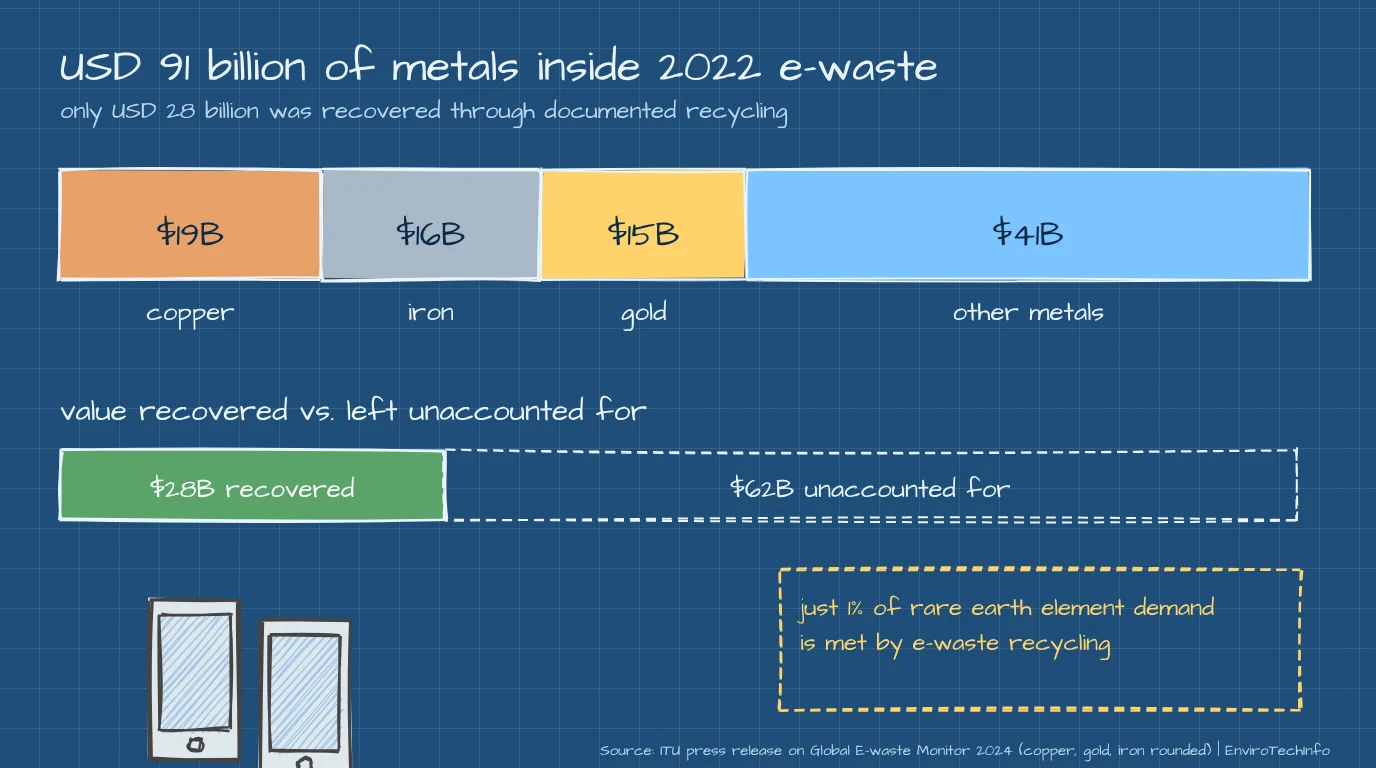
- The e-waste generated in 2022 contained an estimated 31 million tonnes of metals, 17 million tonnes of plastics and 14 million tonnes of other materials.
- The metals were worth about USD 91 billion, including USD 19 billion in copper, USD 15 billion in gold and USD 16 billion in iron.
- Documented recycling recovered about USD 28 billion of secondary raw materials, leaving USD 62 billion of recoverable resources unaccounted for.
- Just 1% of the demand for rare earth elements is met by e-waste recycling.
- Every year, 58,000 kg of mercury and 45 million kg of plastics containing brominated flame retardants are released into the environment from e-waste.
- Small electronic devices make up 33% (20.4 million tonnes) of e-waste, and only 12% of them are recycled.
- Waste from retired solar panels is expected to reach 2.4 million tonnes in 2030, four times the 600,000 tonnes of 2022.
- For every million cell phones recycled, about 35,000 pounds of copper, 772 pounds of silver, 75 pounds of gold and 33 pounds of palladium can be recovered (U.S. EPA).
E-Waste in the United States and the European Union
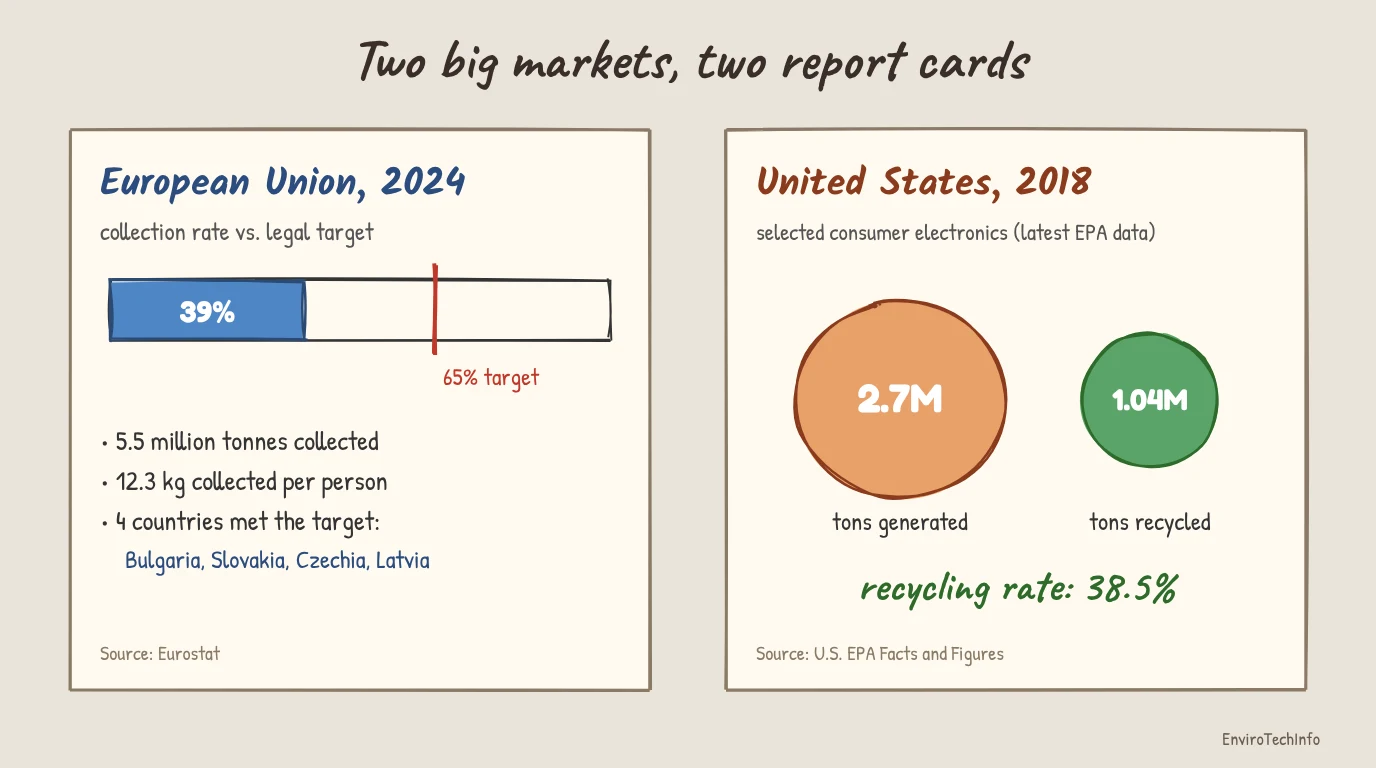
The two biggest Western markets measure e-waste in different ways, so their figures are not directly comparable. The EU reports how much it collects against a legal target every year. The U.S. EPA tracks a narrower group it calls selected consumer electronics, such as TVs, computers and phones, and its most recent national data is from 2018, so keep that in mind when you compare.
- The U.S. generated 2.7 million tons of selected consumer electronics in 2018, less than 1% of all municipal solid waste.
- About 1.04 million tons were recycled, a recycling rate of 38.5%.
- The amount of electrical and electronic equipment placed on the EU market rose from 8.0 million tonnes in 2015 to 14.6 million tonnes in 2024.
- The EU collected 5.5 million tonnes of e-waste in 2024, or 12.3 kg per person.
- The EU collection rate was 39.0% in 2024, well below the legal target of 65%.
- Only four EU countries reached the 65% target in 2024: Bulgaria (83.1%), Slovakia (67.2%), Czechia (67.0%) and Latvia (65.1%).
How Does E-Waste Affect Human Health?
The danger comes less from the devices themselves and more from how they are broken down. Burning cables to reach the copper, melting circuit boards over open fires and dumping old electronics in the open all release toxic substances, and the World Health Organization says children and pregnant women are the most exposed.
- When e-waste is recycled with unsound methods, it can release up to 1,000 different chemical substances into the environment.
- E-waste contains known neurotoxicants, including lead and mercury, that may disrupt the development of the central nervous system.
- Toxic chemicals released by e-waste recycling, such as mercury, can cross the placenta and may contaminate breast milk.
- Exposure has been linked to stillbirth and premature birth, reduced lung function and higher rates of asthma.
- The ILO estimated that as many as 16.5 million children were working in the industrial sector in 2020, which includes waste processing. How many work in e-waste recycling specifically is unknown.
E-Waste Laws, Climate Impact and the Case for Recycling
- 81 countries had e-waste policies or legislation in 2023, up from 78 in 2019. Of these, 67 had a legal instrument governing e-waste management.
- Only 46 countries have e-waste collection rate targets, and only 36 have recycling rate targets.
- Documented e-waste recycling avoided about 93 million tonnes of CO2-equivalent emissions and 900 million tonnes of primary ore extraction.
- Raising collection and recycling to 60% by 2030 would bring benefits that exceed the costs by more than USD 38 billion.
Laws are spreading, but slowly, and recycling does more for the climate than most people realise. If you want to do something about these numbers at home, my guide to eco-conscious tech waste solutions walks through how to repair, pass on and recycle old devices safely.
Use These Charts on Your Website
Teachers, students, journalists and fellow bloggers are welcome to use any chart on this page for free. Just copy the code under the chart you want and paste it into your page, and please keep the credit link so your readers can find the original sources too.
Global e-waste in 2022 and forecast for 2030
<a href="https://envirotechinfo.com/recycling-waste/e-waste-statistics/"><img src="https://envirotechinfo.com/wp-content/uploads/2026/11/e-waste-statistics-2022-where-it-went.webp" alt="Global e-waste in 2022 and forecast for 2030" width="1376" height="768" /></a><br />Chart: <a href="https://envirotechinfo.com/recycling-waste/e-waste-statistics/">EnviroTechInfo e-waste statistics</a>
E-waste per person and recycling rate by region
<a href="https://envirotechinfo.com/recycling-waste/e-waste-statistics/"><img src="https://envirotechinfo.com/wp-content/uploads/2026/11/e-waste-by-region-per-person-and-recycling-rate.webp" alt="E-waste per person and recycling rate by region" width="1376" height="768" /></a><br />Chart: <a href="https://envirotechinfo.com/recycling-waste/e-waste-statistics/">EnviroTechInfo e-waste statistics</a>
Value of metals in e-waste
<a href="https://envirotechinfo.com/recycling-waste/e-waste-statistics/"><img src="https://envirotechinfo.com/wp-content/uploads/2026/11/e-waste-metals-value-91-billion.webp" alt="Value of metals in e-waste" width="1376" height="768" /></a><br />Chart: <a href="https://envirotechinfo.com/recycling-waste/e-waste-statistics/">EnviroTechInfo e-waste statistics</a>
EU and US e-waste recycling rates
<a href="https://envirotechinfo.com/recycling-waste/e-waste-statistics/"><img src="https://envirotechinfo.com/wp-content/uploads/2026/11/eu-and-us-e-waste-recycling-rates.webp" alt="EU and US e-waste recycling rates" width="1376" height="768" /></a><br />Chart: <a href="https://envirotechinfo.com/recycling-waste/e-waste-statistics/">EnviroTechInfo e-waste statistics</a>
How to Cite This Page
EnviroTechInfo (2026). E-Waste Statistics 2026: Global, U.S. and EU Data. Retrieved from https://envirotechinfo.com/recycling-waste/e-waste-statistics/
If you are writing something academic, please also cite the original source linked next to each figure, such as the Global E-waste Monitor 2024.
Frequently Asked Questions
How much e-waste is generated each year?
The latest global count found 62 million tonnes of e-waste generated in 2022, and the total is expected to reach 82 million tonnes by 2030 (Global E-waste Monitor 2024).
What percentage of e-waste is recycled?
Worldwide, 22.3% of e-waste was documented as formally collected and recycled in 2022. The EU collected 39% in 2024 against a 65% target, and the U.S. recycled 38.5% of selected consumer electronics in 2018, the latest year of EPA data.
Which region produces the most e-waste per person?
Europe, at 17.6 kg per person in 2022, followed by Oceania at 16.1 kg and the Americas at 14.1 kg.
Why is e-waste dangerous?
Unsafe recycling, such as burning or melting devices, can release up to 1,000 different chemicals, including lead and mercury, which can harm the developing brain. The WHO says children and pregnant women are the most at risk.
How much is e-waste worth?
The metals in 2022 e-waste were worth about USD 91 billion, but only about USD 28 billion was recovered through documented recycling.
How can I dispose of e-waste responsibly?
Repair or pass on devices that still work, then take the rest to a certified e-waste recycler or a retailer take-back program, and remove batteries for separate collection where possible. Our tech waste guide covers each step.
Sources
- ITU and UNITAR, Global E-waste Monitor 2024 press release (20 March 2024)
- ITU, Global E-waste Monitor 2024 highlights (PDF)
- World Health Organization, Electronic waste (e-waste) fact sheet (1 October 2024)
- Eurostat, Waste statistics: electrical and electronic equipment (2024 data)
- U.S. EPA, Durable Goods: Product-Specific Data (data through 2018)
- U.S. EPA, National Overview: Facts and Figures on Materials, Wastes and Recycling
- U.S. EPA, news release on electronics recycling (archived)