
Every year in the United States, carbon monoxide (CO) poisoning sends more than 50,000 people to emergency departments and claims roughly 400 lives in non-fire related incidents, according to the Centers for Disease Control and Prevention. The gas is colourless, odourless, and physiologically devastating at concentrations that household instruments can detect with remarkable precision, but only when those instruments are correctly placed. That placement is not a matter of personal preference. It is governed by combustion physics, thermal air dynamics, and legally binding residential code.
This guide addresses a specific and technically misunderstood question: how far should a CO detector be positioned from a residential furnace, and why does that distance matter at all? The answer involves understanding plume behaviour, sensor interference, fuel-type differences, and the seasonal dormancy of heating systems. Getting it wrong does not simply produce an occasional false alarm. It can leave an entire household unprotected during the exact moments they are most at risk.
Thermal Placement Guidelines and the 20-Foot Safety Margin
The recommendation to place a carbon monoxide detector no closer than 20 feet from a furnace is not arbitrary. It originates from the thermal and chemical behaviour of combustion exhaust during normal furnace operation. When a gas or oil furnace ignites, it produces a short-duration surge of partially combusted gases, including CO, before the burner reaches full operating temperature and combustion efficiency stabilises. This warm-up phase generates localised CO concentrations that may temporarily exceed alarm thresholds even in a properly functioning system.
The 20-foot safety margin is a buffer that prevents a detector from registering these normal startup transients as emergencies. At that distance, the combustion byproducts have dispersed sufficiently through ambient room air so that the detector reads only the background residential CO level, not the furnace startup plume. This is critical because a detector positioned too close will alarm repeatedly during routine ignition cycles, leading residents to disable or remove the device entirely and eliminating all protection in the process.
Installation Best Practice: Position your primary CO detector at least 20 feet from the furnace on the same floor level. If the utility room does not allow this clearance, mount the detector immediately outside the utility room door at corridor level and install a second unit in the nearest sleeping area. Both placements are valid under NFPA 720.
Detector height matters alongside horizontal distance. Because CO has a density nearly identical to air (molecular weight 28 vs. air’s approximate 28.97), it does not stratify the way propane or radon does. The National Fire Protection Association’s NFPA 720 standard accordingly permits wall mounting between five and seven feet above the floor, or ceiling mounting, without bias toward one over the other. The dominant guidance is to mount on every level of the dwelling and within ten feet of each sleeping area, not simply near the furnace.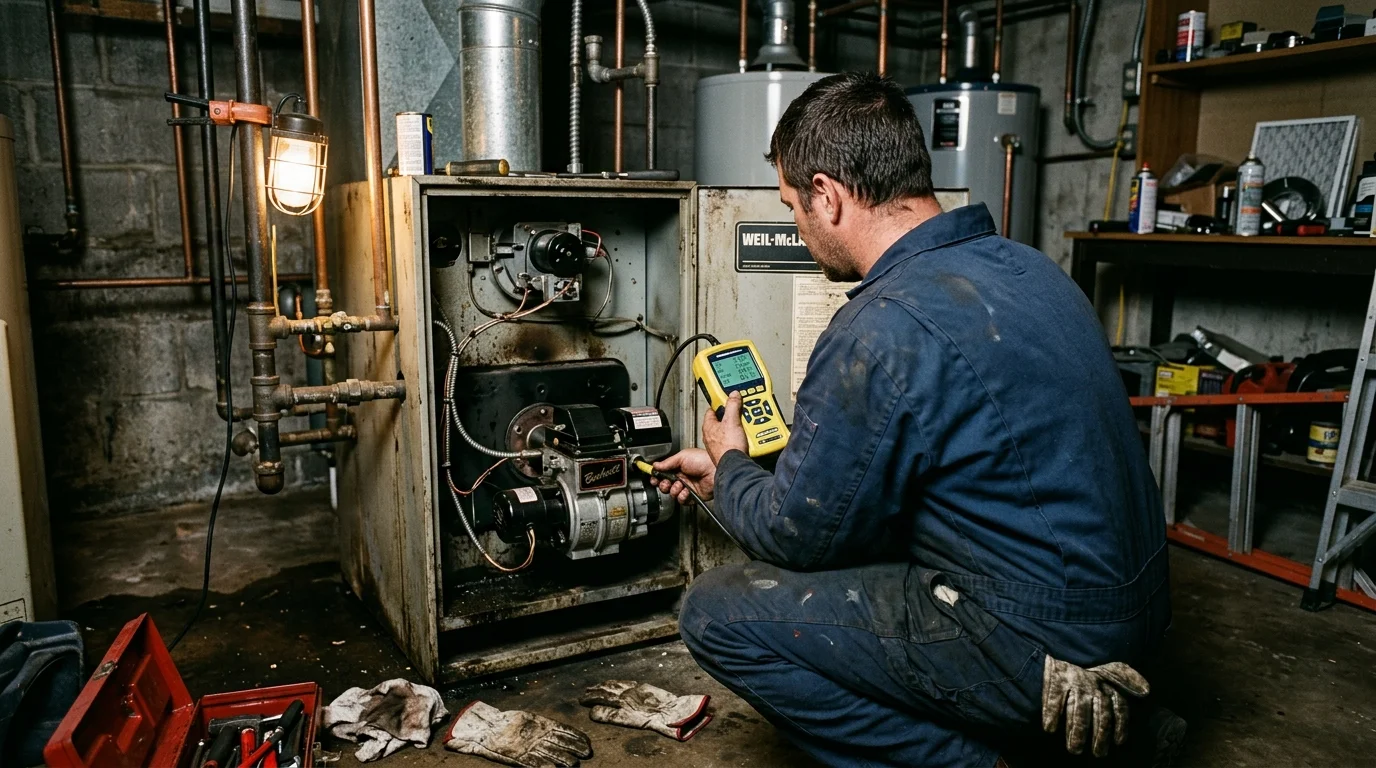
Investigating Carbon Monoxide Potential in Gas and Oil Units
Natural gas furnaces and oil-fired boilers produce carbon monoxide through the same fundamental mechanism: incomplete combustion. When the hydrocarbon fuel does not receive sufficient oxygen during the oxidation reaction, carbon atoms bond to a single oxygen atom (CO) rather than two (CO2). A properly maintained gas furnace operating at its rated air-to-fuel ratio typically produces flue gas concentrations in the range of 50 to 100 parts per million (ppm) of CO, nearly all of which exits through the flue and exhaust vent. The residual CO that enters living space under normal conditions is far below hazardous levels.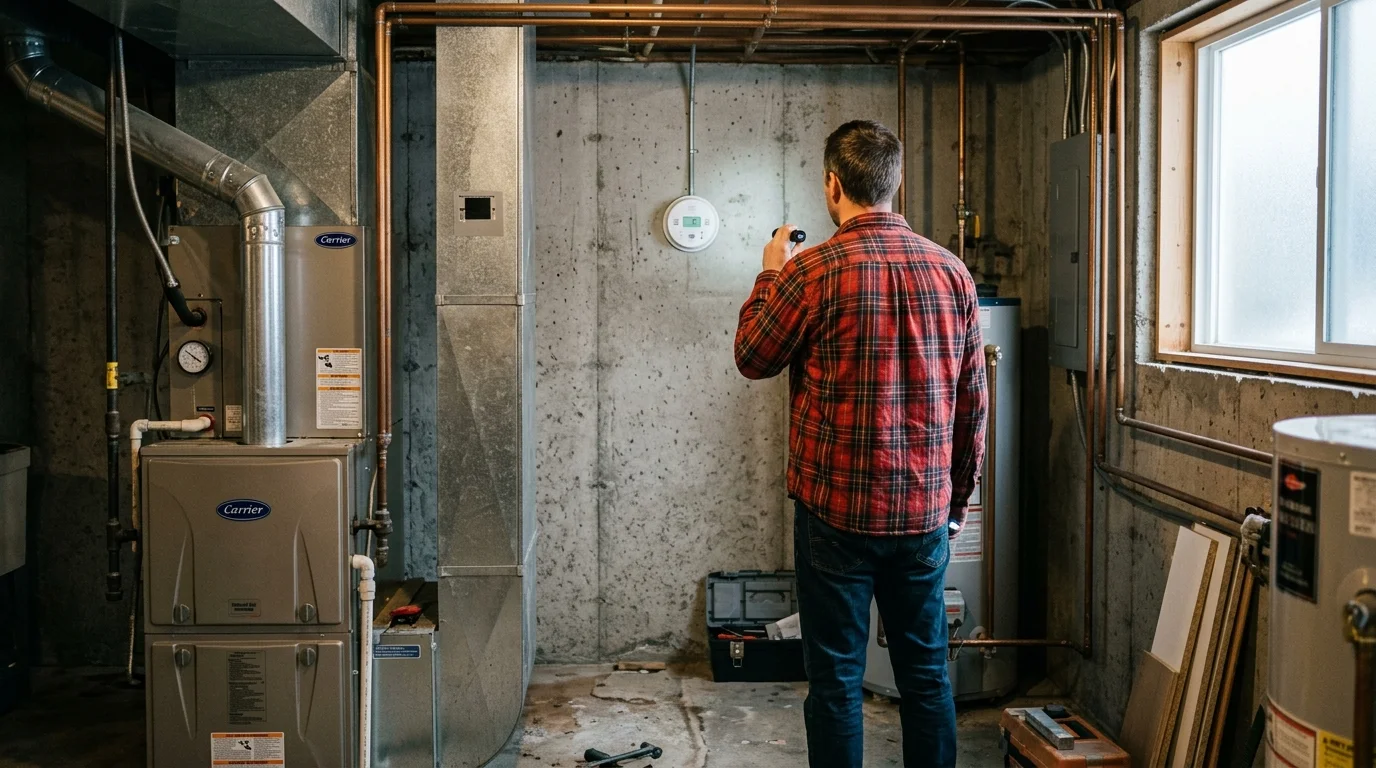
Oil-fired furnaces and boilers present a statistically higher CO risk than their natural gas counterparts under degraded operating conditions. The heavier hydrocarbon chains in heating oil are more sensitive to burner misalignment, nozzle wear, and heat exchanger scaling. A mis-atomised oil burner can produce flue CO concentrations exceeding 2,000 ppm, a level that becomes life-threatening within hours if the exchange surfaces are compromised. We cover the full spectrum of these failure modes and their household impact in our dedicated guide on whether oil heat can cause carbon monoxide poisoning. Homeowners relying on oil heat should treat annual professional servicing not as optional maintenance but as a foundational safety requirement.
The EPA’s technical guidance on residential combustion appliances confirms that even units operating within manufacturer specifications can produce elevated indoor CO under poor ventilation conditions. For verified threshold data and maintenance protocols, see the EPA’s Indoor Air Quality resource on carbon monoxide.
Interference Risks in Close Proximity to Furnace Exhaust
Positioning a CO detector within the interference zone of a furnace exhaust presents two distinct failure modes. The first is the false-alarm problem: the sensor interprets startup-phase CO as a hazardous event and triggers unnecessarily. The second failure mode is subtler and more dangerous. Electrochemical CO sensors, which are the dominant technology in residential detectors, are vulnerable to sensor saturation when exposed to sustained high concentrations. A unit placed directly adjacent to a leaking flue connection may spike to its maximum reading and then reset, giving the false impression that the event has resolved when the source remains active.
Exhaust backflow is a particularly hazardous form of proximity risk. When a furnace flue becomes partially blocked by debris, bird nests, or ice dams in winter, negative pressure inside the heat exchanger can reverse the exhaust draft, forcing combustion gases into the surrounding utility space. A detector mounted within five feet of the flue collar will receive a concentrated, high-velocity plume of CO that may exceed its calibrated measurement range. A detector at the recommended 20-foot clearance will detect the same event at a diluted but still alarm-triggering concentration, giving occupants meaningful time to evacuate.
“Sensor saturation from proximity to an active exhaust source is one of the least understood failure modes in residential CO detection. Distance is not merely a comfort margin. It is the engineering condition under which the sensor’s calibration remains valid.” — Environmental Instrumentation Principles, Applied Indoor Air Science
The Technical Truth About Electric Furnaces and CO Risks
Electric furnaces do not produce carbon monoxide. This statement is unconditional. The heating mechanism in an electric resistance furnace involves passing electrical current through nichrome or similar resistance wire elements, which convert electrical energy directly to radiant heat through the Joule heating effect. There is no combustion reaction, no fuel oxidation, and consequently no CO generation from the furnace itself. Homeowners with all-electric heating systems who install CO detectors solely on the basis of furnace proximity requirements are reacting to a risk that does not exist from their primary heating appliance.
However, the conclusion that an all-electric home requires no CO detectors is dangerously incorrect. CO detection in electrically heated homes remains necessary because gas appliances, fuel-burning vehicles in attached garages, gas ranges, fireplaces, backup generators, and wood-burning stoves are all independent CO sources. The same logic applies to central air systems: while the air handling unit itself carries no combustion risk, the broader HVAC assembly in mixed-fuel homes can still be implicated in CO distribution, a relationship we examine thoroughly in our article on whether HVAC systems can produce carbon monoxide. NFPA 720 requires CO detectors in all dwelling units regardless of heating fuel type, precisely because these secondary sources operate independently of the primary heating system.
Secondary Risks in Homes with Multiple Fuel Sources
A significant proportion of North American homes operate in what environmental scientists term a mixed-fuel environment: electric primary heating combined with a gas range, a gas water heater, or a wood-burning fireplace. These configurations are common in regions where electricity is used for space heating but natural gas is retained for cooking or domestic hot water due to operating cost differentials. Each combustion appliance in such a home constitutes an independent CO source with its own spatial risk profile and maintenance requirements.
The compounding risk in mixed-fuel homes is that homeowners often apply a mental model calibrated to their primary heating system. In a home with an electric furnace and a gas range, the occupants may correctly understand that the furnace poses no CO risk while underestimating the range, particularly if the range is used in a poorly ventilated kitchen during winter when exterior windows remain closed. Unvented gas combustion appliances in enclosed spaces can raise ambient CO concentrations to hazardous levels within 30 to 45 minutes of sustained use without supplemental ventilation.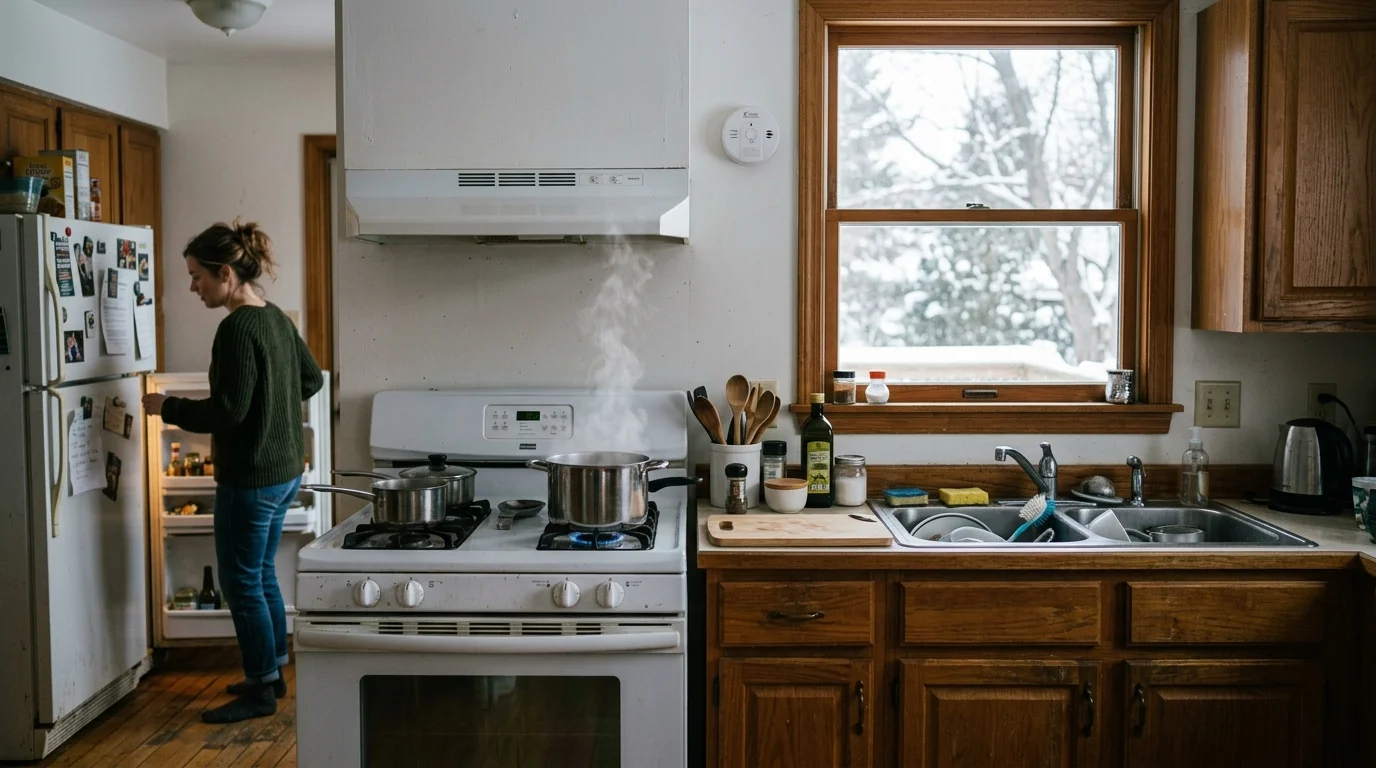
Potential Hazards During System Shutdown and Dormant Cycles
One of the most underappreciated CO risk windows in residential environments is the period immediately following furnace shutdown after an extended heating cycle. During operation, the burner sustains a constant positive pressure differential across the heat exchanger, which maintains directional exhaust flow toward the flue. When the burner extinguishes and the heat exchanger begins to cool, this pressure differential equalises. Residual combustion gases trapped within the exchanger and the lower flue sections can migrate backward into the surrounding air space through micro-cracks or compromised exchanger seams during this equalisation phase.
This phenomenon, sometimes called post-combustion off-gassing, rarely produces concentrations high enough to trigger an alarm from a properly positioned detector under normal conditions. The exception occurs in furnaces with aging or cracked heat exchangers, where the surface area of compromised material is sufficient to allow meaningful gas transfer. Inspectors routinely use combustion analysers to test exchanger integrity by introducing a tracer gas into the combustion chamber and monitoring the supply airstream for contamination. Homeowners should request this specific test during annual service calls, particularly for furnaces older than 15 years.
Dormant Season Risk Factor: When a gas or oil furnace sits dormant through summer months, flue seals can dry and contract, pilot assemblies on older units can accumulate corrosion, and the flue itself may host debris from wildlife activity. The first heating cycle of the autumn season statistically represents an elevated ignition-phase CO event. Test and replace CO detector batteries before the start of each heating season, not in the spring after the season ends.
Seasonal dormancy also affects the detector itself. Electrochemical CO sensors have a finite operational lifespan, typically five to seven years, and the electrochemical solution within the cell can partially dehydrate during extended periods of low humidity in air-conditioned summer interiors. A sensor that reads accurately in spring may exhibit reduced sensitivity by the time the heating season begins in autumn. The practical implication is that CO detectors should be tested monthly using the unit’s test button and replaced on the manufacturer’s stated schedule, not simply when the low-battery indicator activates.
Safety Standards for Residential Air Quality Compliance
Residential CO detector compliance in the United States is governed primarily by three overlapping frameworks. The first is UL 2034, the Underwriters Laboratories standard that defines sensor sensitivity thresholds and alarm timing requirements for residential CO alarms. Under UL 2034, a compliant detector must not alarm below 30 ppm at any duration, must alarm within 189 minutes at 70 ppm, and must alarm within 50 minutes at 150 ppm. These thresholds are calibrated to provide alarm activation before physiologically significant carboxyhaemoglobin saturation occurs in a healthy adult, with additional conservatism built in for children, the elderly, and individuals with cardiovascular or respiratory conditions.
The second framework is NFPA 720, the Standard for the Installation of Carbon Monoxide Detection and Warning Equipment, which specifies where detectors must be placed within a dwelling, how many units are required per floor, the requirement for placement near sleeping areas, and the interconnection requirements that ensure an alarm in one unit triggers all units in the home. State and municipal building codes typically adopt NFPA 720 by reference, making it the de facto national installation standard even though the U.S. has no single federal CO detector mandate.
| Standard / Agency | CO Threshold | Required Response Time | Applicability |
|---|---|---|---|
| UL 2034 | 70 ppm | Alarm within 60–189 minutes | Residential CO alarms (U.S.) |
| UL 2034 | 150 ppm | Alarm within 10–50 minutes | Residential CO alarms (U.S.) |
| UL 2034 | 400 ppm | Alarm within 4–15 minutes | Residential CO alarms (U.S.) |
| OSHA PEL | 50 ppm | 8-hour TWA ceiling | Occupational exposure |
| WHO Guideline | 10 mg/m³ (9 ppm) | 8-hour indoor air quality | Residential indoor air |
| NFPA 720 | Per UL 2034 | Installation standard | Detector placement and interconnection |
The third framework is insurance and liability compliance, which is often overlooked by homeowners. Many homeowner’s insurance policies now include explicit clauses requiring functional CO detection equipment as a condition of coverage for CO-related incidents. In the event of a CO poisoning claim, insurers will examine whether detectors were installed in code-compliant locations and whether they were within their rated service life. A detector mounted directly beside the furnace, or a unit older than its stated replacement date, may constitute a material non-compliance that directly affects claim outcomes.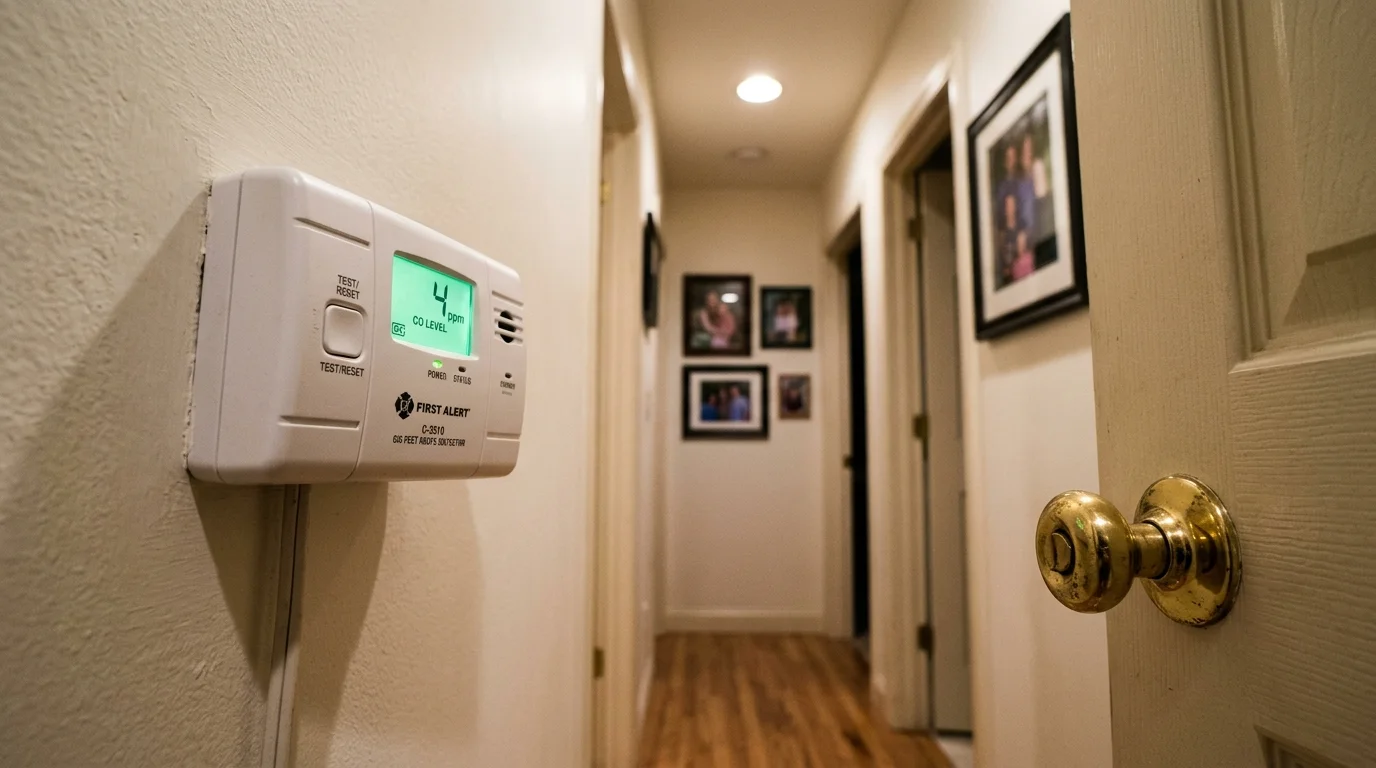
Annual professional furnace inspection, monthly detector testing, and decadal detector replacement are not redundant precautions. They form a layered residential air quality compliance system in which each element compensates for the limitations of the others. The furnace inspection identifies mechanical failure before it produces hazardous output. The detector provides real-time monitoring for both furnace-related and secondary CO sources. And the replacement schedule ensures that the detector’s electrochemical sensitivity remains within the calibrated range that UL 2034 certification requires. No single layer is sufficient on its own.