
You’re driving to work on a crisp, cold morning when you see the yellow tire pressure warning light on your dashboard. If you use nitrogen in your tires, you might wonder, “I paid for nitrogen because it’s more stable… so what’s going on here?”
It’s a great question. The short answer is: Yes, nitrogen pressure absolutely changes with temperature.
But why? And if it changes, why do people say nitrogen is better? This isn’t just a quirk of nitrogen; it’s a fundamental law of physics that affects everything from your bicycle tires to jumbo jets. Let’s break down the science in a way that’s easy to understand.
The Short Answer: It’s a Law of Nature
Think of gases like they’re a crowd of tiny, hyperactive balls bouncing around in a closed space. When you heat these balls up, they get more energy and bounce around much faster and harder. This increased bouncing pushes harder against the walls of their container whether it’s a tire, a balloon, or a tank.
This is why pressure increases when temperature rises. Conversely, when it gets cold, the gas molecules slow down and push with less force, causing the pressure to drop. This rule applies to every gas, including nitrogen. So, while nitrogen has advantages, immunity to temperature isn’t one of them.
The Simple Science: The Gas Law That Rules Them All
Scientists describe this behavior with a principle called the Ideal Gas Law. Don’t let the name intimidate you. We can simplify it:
Imagine a gas inside a rigid container like a tire. Three key things are at play:
1. Pressure (P): The force the gas exerts.
2. Temperature (T): How hot or cold the gas is.
3. Volume (V): The space the gas takes up (which is fixed in a tire).
The law shows a direct relationship: If the volume stays the same, the pressure goes up and down with the temperature.
· Hot Day/Long Drive: Temperature ↑ = Pressure ↑
· Cold Night/Morning: Temperature ↓ = Pressure ↓
It’s as simple and unavoidable as that.
Nitrogen vs. Regular Air: What’s the Real Difference?
This is where people get confused. If both are affected by temperature, what’s the point of using nitrogen?
The key difference is moisture.
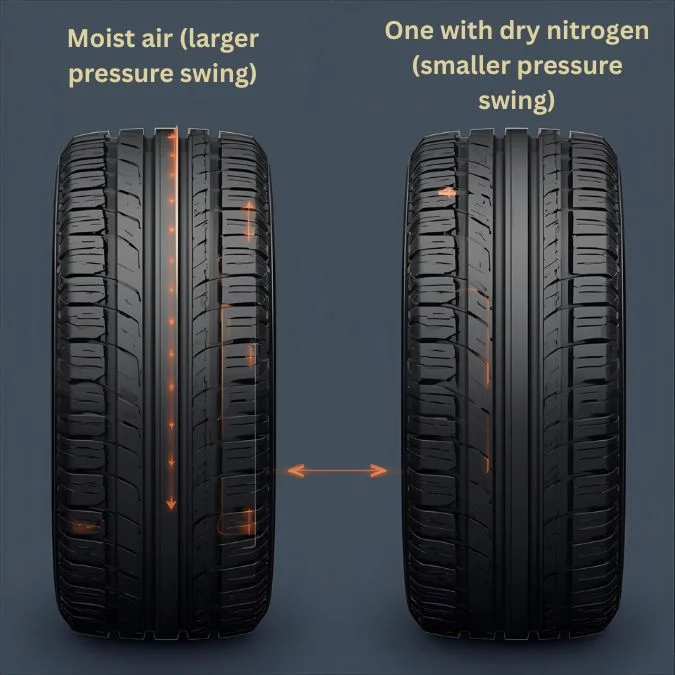
· Compressed Air: The air from a typical gas station compressor contains water vapor. Water is a problem because it can condense from a gas into a liquid when it gets cold. This liquid takes up less space, causing a much more significant pressure drop. It can also lead to rust inside your wheels.
· Pure Nitrogen: Nitrogen is a dry gas. It doesn’t contain water vapor. Because it’s dry, its pressure response to temperature change is more predictable and stable. It changes less dramatically than moist air.
Think of it this way: Nitrogen follows the temperature-pressure rule perfectly. Regular air follows the same rule, but the water inside makes it behave more erratically, like a less reliable follower.
See It in Action: Real-World Examples
This isn’t just theory. You see this effect every day.
· Car and Bicycle Tires: Your tire pressure can drop about 1-2 PSI for every 10°F (5.5°C) drop in temperature. That’s why the warning light often comes on with the first cold snap of fall. After a long, hot drive, the pressure inside your tires will be higher than when you started.
· Aircraft Tires: This is a critical application. Jetliners experience extreme temperature changes, from a hot tarmac to the freezing cold of high altitude. They use pure, dry nitrogen for maximum stability and to prevent internal rusting, which is a major safety concern.
· Scuba Tanks: If a diver fills their tank on a hot day and then jumps into cold water, the pressure inside the tank will decrease. Divers must account for this to ensure they have enough air for their entire dive.
Conclusion:
So, does nitrogen pressure change with temperature? Absolutely.
It’s a universal rule of physics. Nitrogen’s real value isn’t that it ignores temperature changes, but that it responds to them in a more stable and predictable way because it’s dry.
FAQ’s
1. Does nitrogen leak out of tires slower than air?
Yes, typically. A nitrogen molecule is slightly larger than an oxygen molecule (the main component of air that leaks out). More importantly, without moisture, there’s no corrosion to damage the wheel rim and create leak paths. This helps maintain pressure longer.
2. Is it worth the money to put nitrogen in my car tires?
For the average driver, the benefits are modest. The main advantage is more stable pressure, which can lead to more consistent fuel economy and tire wear. For most people, regularly checking and maintaining tire pressure with regular air is perfectly fine. The decision often comes down to cost and convenience.
3. Can I mix regular air with nitrogen in my tires?
Yes, you can. It’s perfectly safe in a pinch. The only downside is that you are diluting the purity of the nitrogen, reducing its benefits (like dryness). If you need to add air, it’s better to top it off with nitrogen later if you want to maintain high purity.